
Maryland and Mike Locksley mutually parted ways on October 21 and a national search by Athletic Director Jim Smith has gotten underway for the school’s next head football coach.
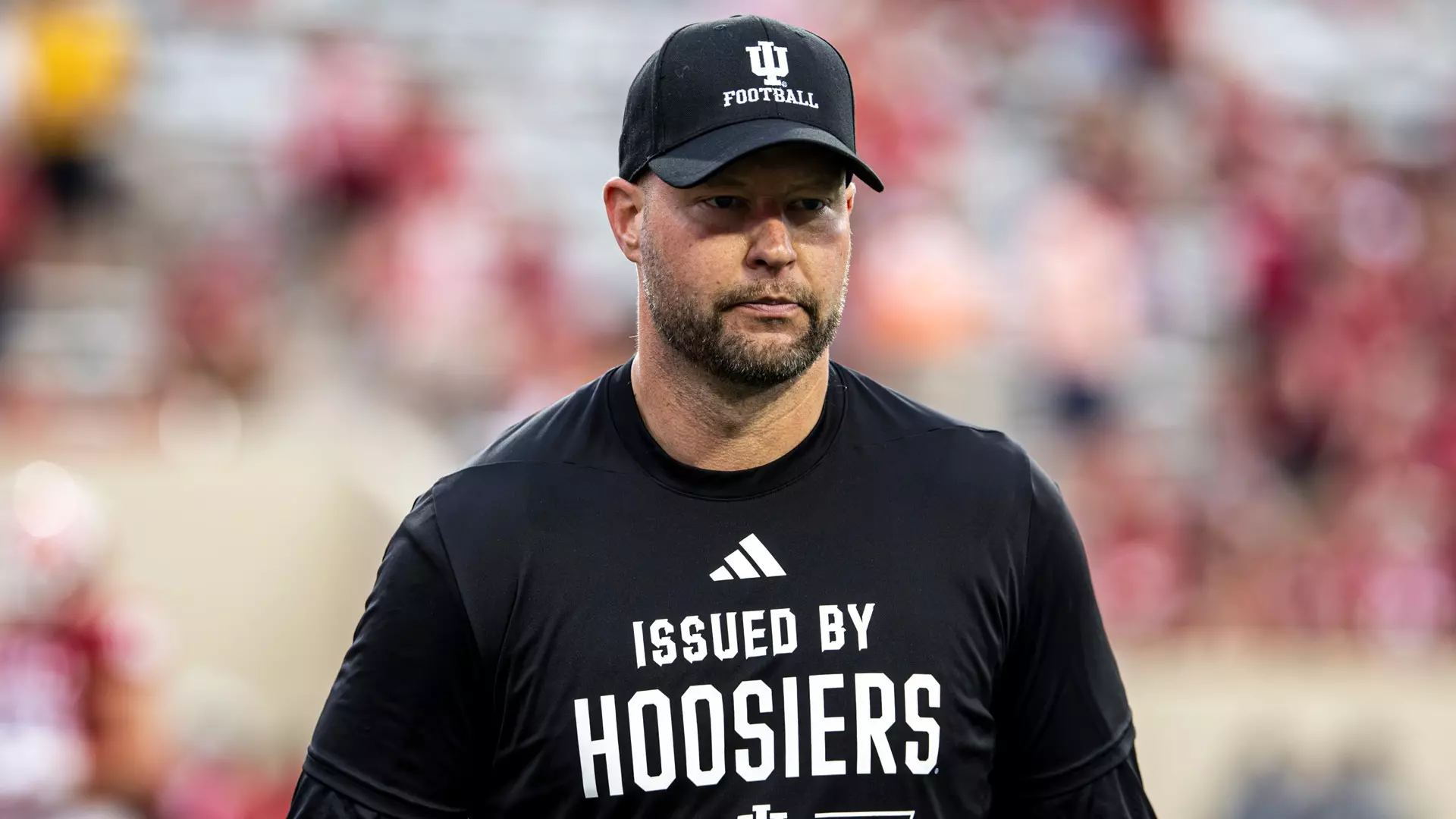
TerrapinHoops will examine many of the candidates being discussed for the job over the coming days and weeks. Our ninth profile takes a look at Indiana defensive coordinator Bryant Haines.
Previously: Charles Huff, Jake Dickert, Jason Eck, Dan Mullen, Brian Hartline, Arthur Smith, Dennard Wilson, JaMarcus Shephard
Current position: Indiana defensive coordinator/linebackers coach
Head coaching experience: None
Career head coaching record: N/A
Career conference record: N/A
Bowl games as head coach: 0
Conference championships as head coach: None
Coaching awards: 2025 Broyles Award (nation’s top assistant coach)
Signature accomplishment: Helped Indiana win the 2025 national championship while coordinating one of the nation’s best defenses
Notable coaching stops: Indiana, Ohio State, Indiana University of Pennsylvania, UC Davis, Elon, James Madison
Years working with Curt Cignetti: 12 (2014–present)
When Maryland athletic director Jim Smith evaluates potential candidates to replace Mike Locksley, few assistants can offer a more impressive recent résumé than Indiana defensive coordinator Bryant Haines.
The architect of one of college football’s most dominant defenses, Haines has spent the past three seasons helping Curt Cignetti transform Indiana from a perennial Big Ten also-ran into a national championship program.
His work earned him the 2025 Broyles Award, presented annually to the nation’s top assistant coach, after the Hoosiers captured the national championship behind a defense that ranked among the country’s best in virtually every major statistical category.
Haines has never been a head coach, but his track record of building elite defenses at James Madison and Indiana makes him one of the more intriguing coordinator candidates in Maryland’s search.
He also understands what it takes to win at a program without the traditional resources or recruiting advantages enjoyed by college football’s established powers.
For Maryland, which has struggled to establish a consistent defensive identity throughout much of its Big Ten tenure, that experience could be particularly appealing.
A longtime partnership with Curt Cignetti
Haines’ coaching career has been closely connected to Cignetti, whose remarkable rise through the coaching ranks has included successful stops at Indiana University of Pennsylvania, Elon, James Madison and Indiana.
A former linebacker at Ball State, Haines was a four-year starter for the Cardinals from 2005–08.
He earned Freshman All-America recognition in 2005 and All-Mid-American Conference honors as a senior in 2008.
After graduating in 2009, Haines began his coaching career at Manchester College before spending two seasons at Adrian College, working with the defensive line and strength and conditioning program.
He subsequently gained experience at two Big Ten programs, serving as a defensive graduate assistant at Indiana in 2012 and working with linebackers at Ohio State in 2013.
The Buckeyes completed an undefeated regular season during his year in Columbus.
Haines joined Cignetti’s staff at Indiana University of Pennsylvania in 2014, beginning a professional relationship that has continued through four different programs.
He coached the defensive line and assisted with strength and conditioning at IUP, where the Crimson Hawks developed one of the Pennsylvania State Athletic Conference’s most productive defenses.
In 2015, IUP led the conference in scoring defense, total defense, third-down defense and red-zone defense.
Haines spent the 2016 season coaching linebackers at UC Davis before rejoining Cignetti at Elon in 2017.
During two seasons with the Phoenix, he helped develop linebacker Warren Messer into an All-American and two-time first-team All-Colonial Athletic Association selection.
When Cignetti accepted the head coaching position at James Madison following the 2018 season, Haines accompanied him to Harrisonburg.
That move would provide Haines with his first significant opportunity to build a defense at the coordinator level.
Building a defensive powerhouse at James Madison
Haines served as James Madison’s co-defensive coordinator and linebackers coach from 2019–21 before assuming full defensive coordinator responsibilities in 2022.
The results were outstanding.
During the program’s final seasons at the Football Championship Subdivision level, James Madison consistently ranked among the nation’s leaders in total defense, scoring defense and tackles for loss.
The Dukes produced eight defensive All-Americans during Haines’ five seasons with the program.
In 2019, defensive ends John Daka and Ron’Dell Carter combined for 28.5 sacks, with Daka leading the FCS with 16.5.
Carter earned Colonial Athletic Association Defensive Player of the Year honors and finished as the runner-up for the Buck Buchanan Award, presented to the nation’s top FCS defensive player.
James Madison’s defense continued to excel as the program transitioned to the Football Bowl Subdivision in 2022.
Despite moving into the Sun Belt Conference, the Dukes immediately established themselves as one of the nation’s most physical defensive teams.
In 2022, James Madison ranked second nationally in rushing defense, allowing just 79.5 yards per game.
The Dukes also ranked second nationally with 8.6 tackles for loss per contest.
Those numbers improved the following season.
In 2023, James Madison led the nation in rushing defense, surrendering just 61.5 yards per game.
The Dukes also led the FBS with 9.1 tackles for loss per game, consistently disrupting opposing offenses at the line of scrimmage.
Defensive lineman Jalen Green was particularly dominant, recording 15.5 sacks in just nine games before suffering a season-ending injury.
Green earned Sun Belt Defensive Player of the Year honors.
The success demonstrated Haines’ ability to develop productive defenses even as James Madison transitioned into a higher level of competition.
It also helped establish him as one of the nation’s most promising young defensive coordinators.
When Cignetti left James Madison to become Indiana’s head coach in December 2023, Haines followed him to Bloomington.
Transforming Indiana’s defense
Indiana’s football program had struggled for decades to compete consistently in the Big Ten.
The Hoosiers entered the 2024 season with little expectation of challenging the conference’s traditional powers.
Cignetti and his staff quickly changed that perception.
Indiana finished 11–2 in 2024, reaching the College Football Playoff for the first time in program history.
While much of the attention focused on the Hoosiers’ offensive production and remarkable turnaround, Haines’ defense was equally important.
Indiana led the nation in rushing defense, allowing just 80.2 yards per game.
The Hoosiers also ranked second nationally in total defense, surrendering 256.3 yards per contest, and 10th in passing defense at 176.1 yards per game.
The improvement was particularly striking considering Indiana’s previous struggles against Big Ten competition.
Haines built a unit that was physical against the run, aggressive at the line of scrimmage and disciplined in its assignments.
Linebacker Aiden Fisher emerged as one of the nation’s premier defensive players, earning All-America recognition.
The following season, Indiana reached even greater heights.
The Hoosiers completed a historic 2025 campaign by winning the national championship, establishing themselves as one of college football’s most remarkable turnaround stories.
Haines’ defense was again central to that success.
Indiana finished second nationally in scoring defense, allowing just 11.7 points per game.
The Hoosiers also ranked second in rushing defense at 77.2 yards per game and fourth in total defense, surrendering 266.0 yards per contest.
Those numbers established several program records and reinforced Indiana’s emergence as one of the country’s most complete teams.
Haines’ ability to produce elite results in consecutive seasons earned him the Broyles Award.
The recognition placed him among the nation’s most respected assistant coaches and further strengthened his credentials as a potential head coaching candidate.
He returned to Indiana for the 2026 season, continuing to oversee the Hoosiers’ defense as the program attempts to sustain its unprecedented success.
A defensive identity Maryland desperately needs
Haines’ appeal to Maryland begins with his ability to build defenses capable of competing against more talented opponents.
Throughout much of its Big Ten membership, Maryland has struggled to consistently match the physicality of the conference’s strongest programs.
The Terrapins have produced talented individual defenders, but sustaining success against teams with superior offensive lines and deeper rosters has been a recurring problem.
Haines has demonstrated an ability to address precisely those challenges.
At James Madison, his defenses dominated the line of scrimmage despite the program’s transition from the FCS to the FBS.
At Indiana, he helped transform a program with a long history of defensive struggles into one of the nation’s most effective units.
His defenses have consistently emphasized stopping the run, creating negative plays and forcing opponents into difficult third-down situations.
Those characteristics would provide a strong foundation for Maryland’s attempt to become more competitive in the Big Ten.
Haines also brings considerable familiarity with the conference.
His coaching background includes graduate assistant positions at Indiana and Ohio State, along with three seasons coordinating the Hoosiers’ defense.
He understands the physical demands of Big Ten football and has experienced firsthand what is required to compete against the league’s strongest programs.
Perhaps most importantly, Haines has been part of successful program-building efforts at multiple levels.
His experience alongside Cignetti at IUP, Elon, James Madison and Indiana has exposed him to the organizational principles that helped transform each program.
That background could be valuable for Maryland, which needs more than an effective defensive coordinator.
The Terrapins need a head coach capable of establishing a consistent culture, identifying and developing talent, building an effective staff and creating a program that can sustain success beyond an occasional breakthrough season.
Haines has observed that process throughout his coaching career.
The question is whether he is ready to lead it himself.
The concerns
Despite his impressive résumé, Haines would represent a significant gamble for Maryland.
He has never served as a head coach at any level.
His entire career has been spent working primarily on the defensive side of the ball, and he has not been responsible for overseeing the broader operation of a college football program.
The demands of modern college coaching extend well beyond developing schemes and preparing players for Saturdays.
Head coaches must navigate the transfer portal, NIL compensation, revenue sharing, recruiting budgets and roster management while supervising an increasingly complex organizational structure.
Haines would need to demonstrate that he is prepared to handle those responsibilities.
There is also the question of how much of Indiana’s success can be attributed directly to Haines and how much stems from Cignetti’s broader program-building approach.
The two have worked together for more than a decade, and Haines has never coordinated a defense outside Cignetti’s system.
That continuity has undoubtedly contributed to his success, but it also makes evaluating his ability to lead an independent program more difficult.
Maryland would need to be convinced that Haines could establish his own identity and assemble a staff capable of succeeding without Cignetti.
His offensive coordinator hire would be especially important.
A defensive-minded head coach can succeed in the Big Ten, but Maryland would need a clear plan for recruiting quarterbacks, developing offensive linemen and establishing a productive offense.
There is also considerable competition for coaches with Haines’ credentials.
Winning the Broyles Award and helping Indiana capture a national championship have made him a recognizable name in coaching circles.
His success has generated interest from NFL organizations, and his future opportunities could extend beyond college football.
Maryland would need to present a compelling case that taking over the Terrapins represents the right next step in his career.
The bottom line
Few assistant coaches in college football can match Bryant Haines’ recent accomplishments.
He has helped build dominant defenses at James Madison and Indiana, developed multiple All-Americans and earned national recognition as the country’s top assistant coach.
His experience working alongside Curt Cignetti also gives him an unusually strong background in building successful programs at schools that have historically operated outside college football’s traditional power structure.
Those qualities should make him an appealing candidate for Maryland.
The Terrapins need a coach who can improve their physicality, develop players and establish a consistent identity capable of competing in the Big Ten.
Haines has demonstrated an ability to accomplish those goals as an assistant.
The uncertainty centers on whether he can translate that success into running an entire program.
Hiring Haines would require Maryland to place considerable faith in a first-time head coach whose professional success has been closely tied to one of the nation’s most accomplished program builders.
But if Smith is willing to pursue a rising assistant rather than an established head coach, Haines belongs among the candidates worth serious consideration.
His defensive track record, Big Ten experience and role in Indiana’s remarkable rise make him one of the more intriguing possibilities in Maryland’s search.