
Maryland and Mike Locksley mutually parted ways on October 21 and a national search by Athletic Director Jim Smith has gotten underway for the school’s next head football coach.
TerrapinHoops will examine many of the candidates being discussed for the job over the coming days and weeks. Our sixth profile takes a look at Ohio State offensive coordinator Arthur Smith.
Previously: Charles Huff, Jake Dickert, Jason Eck, Dan Mullen, Brian Hartline
Current position: Ohio State offensive coordinator
Age: 44
Hometown: Memphis, Tennessee
Years as head coach: 3 (2021–23, Atlanta Falcons)
Career head coaching record: 21–30 (.412)
Career conference record: N/A — NFL head coach
Bowl games coached as head coach: 0
NFL playoff appearances as head coach: 0
Conference championships: None
Coaching awards: None as head coach
Signature win: Atlanta Falcons 28, San Francisco 49ers 14 (2022)
Previous head coaching jobs: Atlanta Falcons (2021–23)
Notable assistant stops: North Carolina, Washington Redskins, Ole Miss, Tennessee Titans, Pittsburgh Steelers, Ohio State
National championships as assistant: None
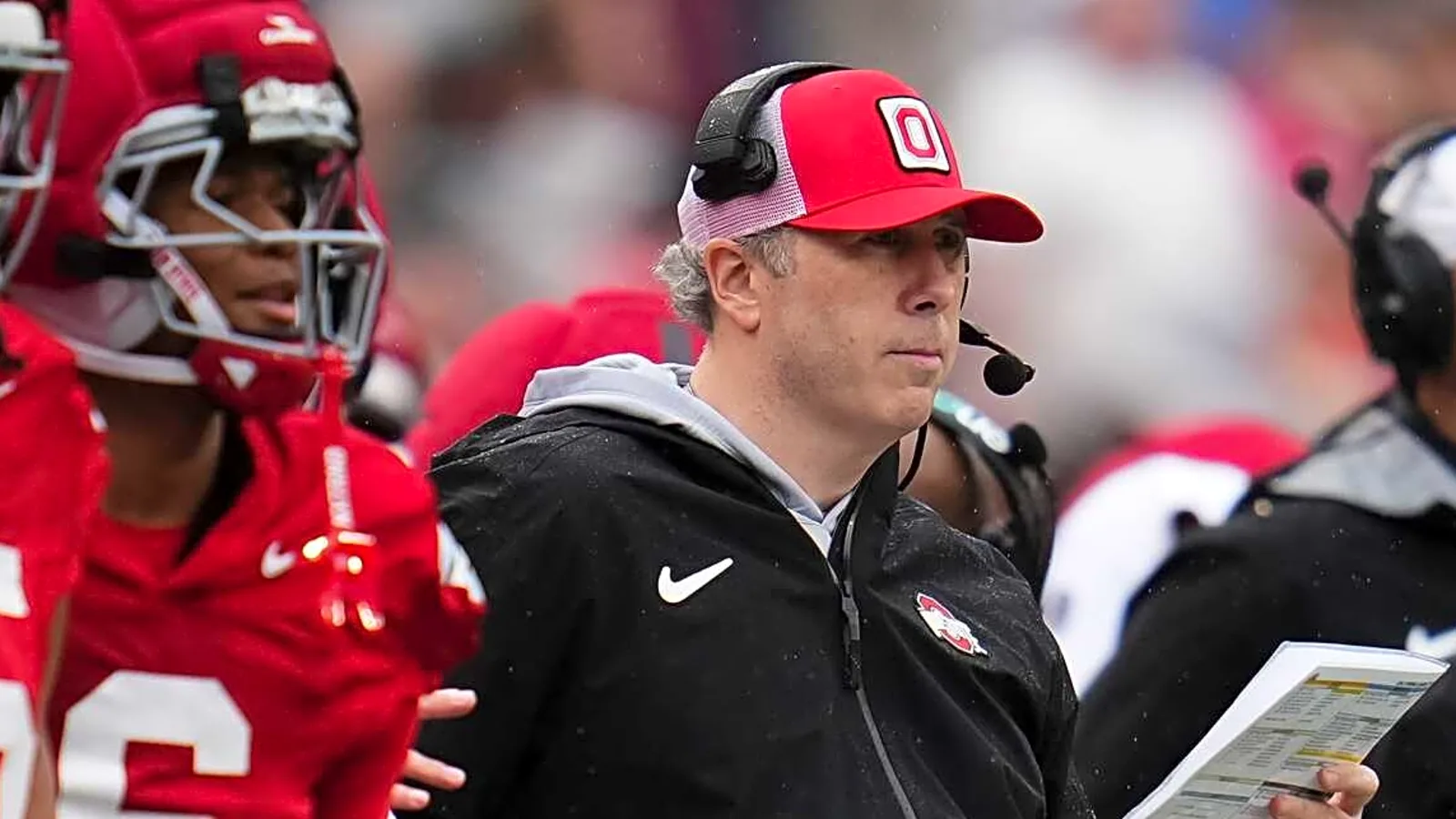
Ohio State offensive coordinator Arthur Smith brings an unusual combination of NFL head-coaching experience, offensive expertise and ties to the Washington metropolitan area as a potential candidate in Maryland’s search for Mike Locksley’s replacement.
The 44-year-old spent three seasons as head coach of the Atlanta Falcons and previously directed some of the NFL’s most productive offenses with the Tennessee Titans. He returned to college football in January when Ohio State hired him to replace Brian Hartline as offensive coordinator.
Although Smith has spent most of his coaching career in the NFL, his background includes connections to Maryland athletic director Jim Smith through both the Falcons and Ohio State, as well as a familiarity with the Washington area dating to his high school years.
A native of Memphis, Tennessee, Smith attended Georgetown Preparatory School in North Bethesda, where he played offensive line before continuing his career at North Carolina.
He played for the Tar Heels from 2001–05 and began his coaching career as a graduate assistant at his alma mater in 2006.
Smith entered the NFL the following year, joining Washington as a defensive quality control coach and college scouting assistant. He spent two seasons with the franchise before returning to college football in 2010 as a defensive intern and administrative assistant at Ole Miss.
His career took a significant step forward in 2011 when he joined the Tennessee Titans.
Over the next decade, Smith worked his way through several positions, beginning as a defensive quality control coach before transitioning to offensive responsibilities.
He served as an offensive quality control coach, assistant offensive line coach and assistant tight ends coach before being promoted to tight ends coach in 2016.
Working under several different head coaches, Smith developed a reputation for his understanding of offensive personnel and his ability to design schemes around the strengths of individual players.
In 2019, Titans head coach Mike Vrabel promoted Smith to offensive coordinator.
The results were immediate.
Tennessee finished 9–7 during the regular season but advanced to the AFC Championship Game after defeating New England and Baltimore in the playoffs.
Smith’s offense relied heavily on running back Derrick Henry and a revitalized Ryan Tannehill, who replaced Marcus Mariota as the team’s starting quarterback during the season.
Tannehill led the NFL with a 117.5 passer rating and earned his first Pro Bowl selection, while Henry led the league with 1,540 rushing yards.
The Titans improved to 11–5 in 2020, winning the AFC South championship behind one of the league’s most productive offenses.
Tennessee ranked second in the NFL in total offense, averaging 396.4 yards per game, and second in rushing offense at 168.1 yards per contest.
Henry rushed for 2,027 yards, becoming just the eighth player in NFL history to surpass 2,000 rushing yards in a season.
Tannehill threw for 3,819 yards and 33 touchdowns, while Tennessee averaged 30.7 points per game.
Smith’s success in Nashville made him one of the NFL’s most sought-after head-coaching candidates.
The Atlanta Falcons hired him in January 2021, giving him his first opportunity to lead a professional franchise.
Smith inherited a team coming off a 4–12 season and facing significant roster and salary-cap challenges.
The Falcons finished 7–10 in his first season, with tight end Kyle Pitts emerging as one of the league’s most productive rookies.
Pitts caught 68 passes for 1,026 yards, becoming just the second rookie tight end in NFL history to surpass 1,000 receiving yards.
Atlanta again finished 7–10 in 2022, although Smith’s offense showed improvement in several areas.
The Falcons ranked among the NFL’s top rushing teams and led the league in fewest penalties.
Rookie running back Tyler Allgeier rushed for 1,035 yards, while wide receiver Drake London caught 72 passes, setting a franchise rookie record.
One of Smith’s most notable victories came in October 2022, when Atlanta defeated San Francisco, 28–14.
The Falcons controlled the game with a physical rushing attack and a defense that limited the 49ers to 14 points.
Despite some encouraging individual performances, Atlanta struggled to establish consistency at quarterback following Matt Ryan’s departure.
The Falcons finished 7–10 for a third consecutive season in 2023, leaving Smith with a 21–30 overall record and no playoff appearances.
Atlanta dismissed him in January 2024.
Smith quickly returned to an offensive coordinator role, joining Mike Tomlin’s staff with the Pittsburgh Steelers.
Pittsburgh improved its rushing production and scoring offense in Smith’s first season, finishing 10–7 and reaching the playoffs.
The Steelers ranked 11th in the NFL in rushing offense, averaging 127.4 yards per game, while increasing their scoring average from 17.9 points in 2023 to 22.4 in 2024.
Smith returned for a second season in 2025, working with veteran quarterback Aaron Rodgers.
Pittsburgh again reached the playoffs, winning the AFC North championship and averaging 23.4 points per game.
Rodgers threw for 3,322 yards and 24 touchdowns with seven interceptions, helping the Steelers produce their highest scoring average since 2020.
After nearly two decades working primarily in the NFL, Smith made a surprising return to college football when Ohio State hired him in January 2026.
Buckeyes head coach Ryan Day selected Smith to replace Hartline, who had departed to become South Florida’s head coach.
Day cited Smith’s experience as an NFL coordinator, play caller and head coach as reasons for the hire.
For Smith, the move provided an opportunity to work at one of college football’s premier programs while adapting his offensive philosophy to the modern college game.
It also placed him in the Big Ten, where he would gain firsthand experience with the conference’s personnel, defensive schemes and competitive demands.
The Maryland connection
Smith’s potential candidacy would carry several connections to Maryland and the surrounding region.
His time at Georgetown Prep provides a direct link to the Washington metropolitan area, although most of his subsequent coaching career has taken place in the NFL.
Smith also comes from one of the country’s most prominent business families.
His father, Frederick W. Smith, founded FedEx in 1973 and built the company into a global transportation and logistics giant, serving as the company’s longtime chairman and CEO.
Arthur Smith has largely established his coaching career independently of his family’s business interests, working his way through entry-level assistant positions before becoming an NFL offensive coordinator and head coach.
Perhaps more relevant to Maryland’s coaching search are his professional connections to organizations familiar to athletic director Jim Smith.
Before arriving in College Park, Jim Smith held senior executive positions with Arthur M. Blank Sports & Entertainment, the parent organization of the Atlanta Falcons and Atlanta United.
His responsibilities included revenue generation, marketing and business operations for the Falcons, as well as work connected to the development of Mercedes-Benz Stadium.
Although Jim Smith had moved on from the organization before Arthur Smith became the Falcons’ head coach in 2021, he maintains relationships with several of the franchise’s senior executives.
Among them is Rich McKay, the longtime Falcons executive who praised Jim Smith following his appointment as Maryland’s athletic director in May 2025.
McKay, who served in senior leadership roles during Arthur Smith’s tenure in Atlanta, could provide a particularly informed perspective on Smith’s three seasons as an NFL head coach.
There is also a connection through Ohio State.
Jim Smith served as president and CEO of the university’s alumni association from 2016–20 and maintains a close professional relationship with former Ohio State athletic director Gene Smith.
Gene Smith has served in an advisory capacity to Maryland’s athletic department since Jim Smith took over in College Park.
Arthur Smith joined Ohio State’s coaching staff in January 2026, several years after Jim Smith departed the university.
Nevertheless, the athletic director’s existing relationships within the Buckeyes’ administration could provide additional insight into Smith’s performance as an offensive coordinator and his transition back to college football.
Those connections would not necessarily make Arthur Smith a leading candidate for the Maryland opening, but they could make him relatively easy for Jim Smith to evaluate.
Through his relationships with executives in Atlanta and administrators at Ohio State, Maryland’s athletic director has potential access to people familiar with Smith’s leadership, offensive philosophy and ability to manage a major football operation.
There is no confirmed indication that Maryland has contacted Smith or that he has expressed interest in the position.
The Maryland fit
Arthur Smith would represent an unconventional hire for Maryland.
Unlike candidates who have spent their careers recruiting and developing college players, Smith has built his reputation almost entirely in professional football.
His experience managing an NFL franchise could be appealing to an athletic department searching for a coach capable of establishing a clear organizational structure and overseeing a large staff.
He also brings an extensive background in offensive development.
At Tennessee, Smith helped transform the Titans into one of the NFL’s most efficient offenses by building around Henry’s physical running style and Tannehill’s strengths as a passer.
His offenses have generally emphasized a productive running game, play-action passing and the effective use of tight ends.
That approach could provide Maryland with a more defined offensive identity, particularly in a Big Ten increasingly shaped by physical line play and strong defensive fronts.
The biggest concern would be Smith’s limited experience with modern college football.
He has never served as a college head coach and has spent only a small portion of his career working in the college game.
Recruiting, transfer portal management, NIL negotiations and roster retention would present challenges that differ significantly from the NFL’s personnel structure.
Although his time at Ohio State provides exposure to those responsibilities, it remains to be seen how effectively he could manage them while leading his own program.
His record in Atlanta also raises questions.
Smith’s Falcons teams showed occasional improvement but never finished with a winning record or reached the playoffs.
While the franchise faced roster limitations during his tenure, three consecutive 7–10 seasons would be difficult to overlook when evaluating his ability to build a successful program.
There is also the question of whether his offensive philosophy would translate effectively to college football, where quarterback development, recruiting advantages and the ability to generate explosive plays often determine success.
Still, Smith offers a combination of experience and connections that few other candidates can match.
He has directed successful NFL offenses, managed a professional franchise and returned to the college game at one of the Big Ten’s most prominent programs.
His background in the Washington area and his ties to organizations familiar to Maryland’s athletic director provide additional reasons for the Terrapins to evaluate his résumé.
For Maryland, hiring Smith would be a bet that an experienced NFL coach can apply his offensive expertise and organizational experience to the college game while adapting to a recruiting environment that has changed dramatically since his last extended stint on a college staff.