
Maryland and Mike Locksley mutually parted ways on October 21 and a national search by Athletic director Jim Smith has gotten underway for the school’s next head football coach.
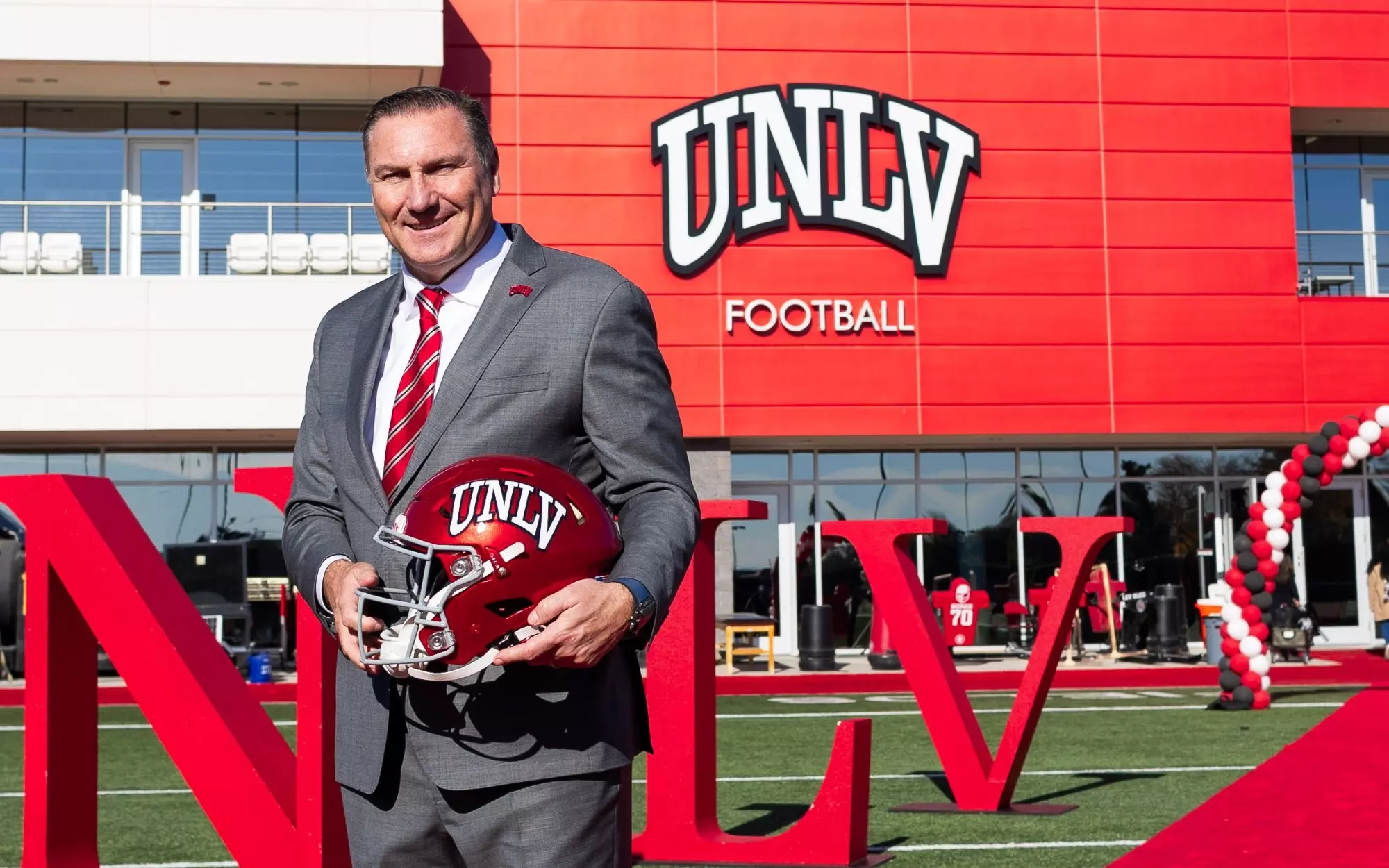
TerrapinHoops will examine many of the candidates being discussed for the job over the coming days and weeks. Our fourth profile takes a look at UNLV head coach Dan Mullen.
Previously: Charles Huff, Jake Dickert, Jason Eck
Current position: UNLV head coach
Age: 54
Hometown: Manchester, New Hampshire
Years as a head coach: 15 (2009–21, 2025–26)
Career head coaching record: 118–68 (.634)
Career conference record: 63–55 (.534)
Bowl games coached: 11 (7–4)
Conference championships: None (2020 SEC East Division champion)
Coaching awards: 2014 National Coach of the Year (Maxwell Football Club); 2014 SEC Coach of the Year; 2025 FWAA Steve Spurrier First-Year Coach of the Year
Signature win: Mississippi State 38, No. 2 Auburn 23 (2014)
Previous head coaching jobs: Mississippi State (2009–17), Florida (2018–21)
Notable assistant stops: Syracuse, Notre Dame, Bowling Green, Utah, Florida
National championships as an assistant: 2 — Florida (2006, 2008)
UNLV head coach Dan Mullen brings one of the most accomplished résumés of any potential candidate in Maryland’s search for Mike Locksley’s replacement.
The 54-year-old has spent 15 seasons as a college head coach, including 13 in the Southeastern Conference, and owns a 118–68 career record with 11 bowl appearances.
He has taken Mississippi State to the No. 1 ranking nationally, led Florida to three consecutive New Year’s Six bowl appearances and helped develop some of college football’s most accomplished quarterbacks.
Now in his second season at UNLV, Mullen has returned to the sidelines after spending three years as an ESPN college football analyst.
His experience stands in contrast to many of the younger coaches connected to Maryland’s opening, several of whom have never led a Power Four program.
A native of Manchester, New Hampshire, Mullen played tight end at Ursinus College in Pennsylvania before beginning his coaching career as a wide receivers coach at Wagner in 1994.
He subsequently coached at Columbia, Syracuse and Notre Dame before joining Urban Meyer’s staff at Bowling Green in 2001.
That relationship would prove instrumental in Mullen’s career.
Mullen followed Meyer to Utah in 2003, serving as quarterbacks coach and helping develop Alex Smith into one of the nation’s top players.
In 2004, Utah went 12–0, won the Mountain West championship and defeated Pittsburgh in the Fiesta Bowl. Smith finished fourth in Heisman Trophy voting before becoming the first overall selection in the 2005 NFL Draft.
When Meyer left Utah for Florida, Mullen followed him to Gainesville as offensive coordinator and quarterbacks coach.
Over the next four seasons, Mullen helped build one of the nation’s most productive offenses.
Florida won national championships in 2006 and 2008, with Mullen playing a central role in the development of quarterback Tim Tebow.
Tebow won the 2007 Heisman Trophy and became one of the most decorated players in college football history.
Mullen’s success at Florida earned him his first head-coaching opportunity when Mississippi State hired him following the 2008 season.
The Bulldogs had struggled to establish themselves as consistent contenders in the SEC West, and Mullen inherited a program that had finished 4–8 the previous year.
After going 5–7 in his first season, Mullen guided Mississippi State to a 9–4 record in 2010, capped by a 52–14 victory over Michigan in the Gator Bowl.
It was the beginning of an extended stretch of success in Starkville.
Mississippi State reached eight consecutive bowl games during Mullen’s tenure, including the 2014 Orange Bowl, and won at least eight games in five of his nine seasons.
His defining season came in 2014.
Led by quarterback Dak Prescott, the Bulldogs opened the season with nine consecutive victories, including three straight wins over nationally ranked opponents.
Mississippi State defeated No. 8 LSU, No. 6 Texas A&M and No. 2 Auburn in successive games, with the 38–23 victory over Auburn helping propel the Bulldogs to the No. 1 ranking in the Associated Press poll.
Mississippi State also became the first team ranked No. 1 in the history of the College Football Playoff rankings.
The Bulldogs eventually finished 10–3, but their rise to the top of the national rankings represented one of the most successful seasons in school history.
Mullen was named the 2014 SEC Coach of the Year and received national coach of the year honors from the Maxwell Football Club.
Prescott, meanwhile, developed into one of the most productive quarterbacks in Mississippi State history before beginning a successful NFL career with the Dallas Cowboys.
Mullen finished his nine seasons at Mississippi State with a 69–46 record, including a 33–39 mark in SEC play.
Florida hired him in November 2017, bringing Mullen back to Gainesville to replace Jim McElwain.
Again, the results were immediate.
The Gators went 10–3 in Mullen’s first season, defeating No. 7 Michigan, 41–15, in the Peach Bowl.
Florida improved to 11–2 in 2019, finishing with a 36–28 victory over Virginia in the Orange Bowl.
Mullen’s third season produced one of the nation’s most explosive offenses.
Led by quarterback Kyle Trask, tight end Kyle Pitts and wide receiver Kadarius Toney, Florida averaged 39.8 points per game in 2020 and won the SEC East.
Trask threw for 4,283 yards and 43 touchdowns in just 12 games, finishing fourth in Heisman Trophy voting.
The Gators defeated Georgia, 44–28, to take control of the division and eventually reached the SEC Championship Game, where they pushed top-ranked Alabama before falling, 52–46.
Florida finished 8–4 following a loss to Oklahoma in the Cotton Bowl, but Mullen’s first three seasons produced a combined 29–9 record and three consecutive New Year’s Six appearances.
The success did not last.
Florida struggled in 2021, losing six of its first 11 games, including five of seven SEC contests.
The Gators also faced questions about recruiting, roster development and the program’s direction as the losses mounted.
Mullen was dismissed in November 2021 with a 34–15 record at Florida.
He spent the next three seasons working for ESPN and ABC before returning to coaching when UNLV hired him in December 2024.
The Rebels were coming off consecutive appearances in the Mountain West Championship Game under Barry Odom, who departed for Purdue.
Mullen inherited a program with considerable momentum but also faced the challenge of replacing key contributors and maintaining the success established by his predecessor.
His first season in Las Vegas exceeded expectations.
UNLV went 10–4 in 2025, giving Mullen more victories in his debut season than any previous head coach in school history.
The Rebels opened 6–0 for the first time since 1974 and finished the regular season 10–2, earning a place in the Mountain West Championship Game.
UNLV finished 6–2 in conference play and reached the Frisco Bowl, where it lost to Ohio, 17–10.
Mullen was named the Football Writers Association of America’s Steve Spurrier First-Year Coach of the Year for his work in Las Vegas.
The Rebels have been less consistent in his second season.
UNLV is 5–3 overall and 3–1 in Mountain West play through eight games in 2026, following Saturday’s 31–24 victory over Northern Illinois.
The Rebels have defeated California, North Dakota State and Hawaii but suffered losses to Memphis, North Texas and Air Force.
A 39–31 victory over California in October gave Mullen another win against a Power Four opponent, although a 44–6 loss at North Texas earlier in the season highlighted the team’s inconsistency.
Through his first 22 games at UNLV, Mullen owns a 15–7 record.
His overall head-coaching record stands at 118–68, including 63–55 in conference games.
For Maryland, Mullen would represent a significantly different hire than a young coordinator or rising Group of Five head coach.
He has already demonstrated that he can build a competitive program in the SEC, manage the expectations of a major college football operation and develop quarterbacks capable of performing at the highest levels of the sport.
His offensive background could be particularly appealing.
From Alex Smith and Tim Tebow to Dak Prescott and Kyle Trask, Mullen has an extensive history of developing productive quarterbacks and designing offenses around their strengths.
That experience could be valuable for a Maryland program looking to establish a more consistent offensive identity while competing against increasingly talented Big Ten defenses.
Mullen also understands the challenges of coaching at a school that must regularly compete against opponents with greater resources.
At Mississippi State, he built a program capable of challenging Alabama, Auburn and LSU despite recruiting and financial disadvantages.
His nine-year tenure in Starkville demonstrated that he could establish sustained success rather than simply produce a single breakthrough season.
There are, however, legitimate questions about his candidacy.
Mullen’s final season at Florida raised concerns about recruiting and his ability to maintain a program’s momentum when results began to decline.
Recruiting would be particularly important at Maryland, where the next coach will need to establish relationships throughout the DMV while navigating the transfer portal and the increasingly expensive competition for talent.
Mullen has extensive experience recruiting in the Southeast but does not possess the same longstanding connections to Maryland and the surrounding region as several other potential candidates.
His age and career trajectory would also distinguish him from coaches looking for their first major opportunity.
At 54, Mullen has already spent more than a decade leading SEC programs, experienced both the heights of national contention and the pressures that come with falling short of expectations, and returned to coaching after three seasons in television.
The question for Maryland would be whether that experience represents the kind of proven leadership the program needs or whether the university would be better served by hiring a younger coach with a longer potential runway.
There is also the matter of his current success at UNLV.
Although Mullen’s first season produced 10 victories, he inherited a program that had already established itself as one of the Mountain West’s strongest under Odom.
His second season has produced a winning record, but the Rebels have yet to demonstrate that they can consistently compete at the same level as Mullen’s best teams.
Still, his résumé offers something few candidates in Maryland’s search can match.
Mullen has won more than 100 games as an SEC head coach, developed multiple NFL quarterbacks, coached in major bowl games and helped win two national championships as an assistant.
For Maryland, he would represent a bet on experience, offensive expertise and a coach who has already demonstrated an ability to win in one of college football’s most demanding conferences.
Whether he could translate that experience into sustained success in the Big Ten would be the central question surrounding his candidacy.