
Maryland and Mike Locksley mutually parted ways on October 21 and a national search by Athletic Director Jim Smith has gotten underway for the school’s next head football coach.
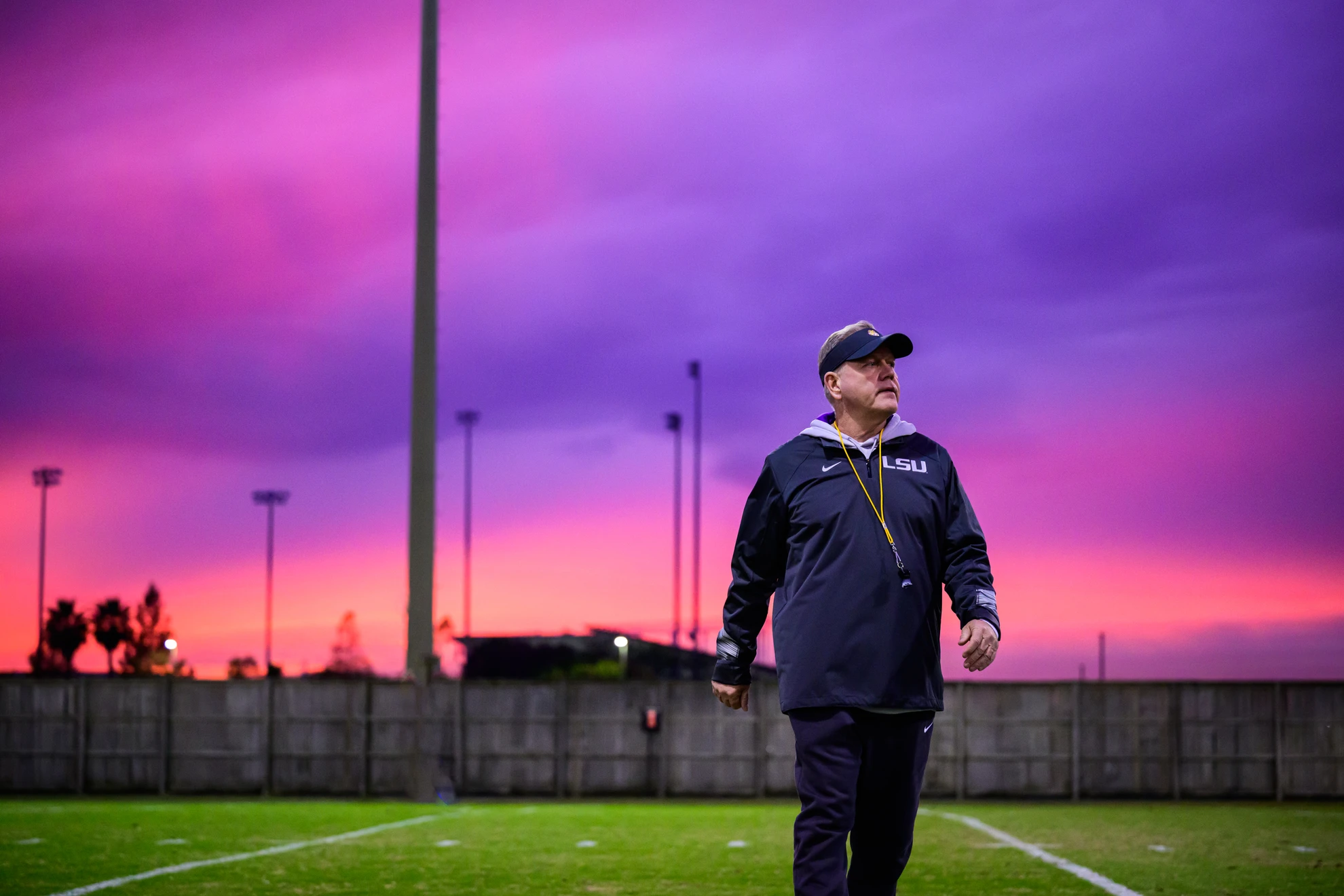
TerrapinHoops will examine many of the candidates being discussed for the job over the coming days and weeks. Our 10th profile takes a look at former LSU head coach Brian Kelly.
Previously: Charles Huff, Jake Dickert, Jason Eck, Dan Mullen, Brian Hartline, Arthur Smith, Dennard Wilson, JaMarcus Shephard, Bryant Haines
Current position: CBS Sports college football analyst; former LSU head coach
Age: 65
Hometown: Everett, Massachusetts
Years as head coach: 35 (1991–2025)
Career head coaching record: 323 victories across Division II and FBS; 200–76 on the field at FBS programs (179–76 after NCAA adjustments)
Conference record: 19–10 in SEC play at LSU
Bowl record: 10–6 at FBS programs
Conference championships: 2 Division II national championships and 13 conference titles across his career, including three Big East championships at Cincinnati
Coaching awards: Two-time AP National Coach of the Year; 2012 Walter Camp and Paul “Bear” Bryant Coach of the Year; three-time Big East Coach of the Year
Signature win: LSU 32, No. 6 Alabama 31 (OT), 2022
Previous head coaching jobs: Grand Valley State (1991–2003), Central Michigan (2004–06), Cincinnati (2006–09), Notre Dame (2010–21), LSU (2022–25)
Brian Kelly has won more than 300 games, coached in a national championship game, guided two programs to the College Football Playoff and spent more than three decades building a reputation as one of college football’s most successful head coaches.
Now, the 65-year-old could be positioning himself for one more opportunity — at Maryland.
Kelly, who was fired by LSU midway through the 2025 season, has emerged as a serious name in the Terrapins’ search for Mike Locksley’s replacement. Multiple reports indicate that Kelly has interviewed with Maryland officials, moving his candidacy beyond the speculation surrounding many of the other coaches connected to the opening.
According to mutiple reports, Kelly met with Maryland officials during the first half of November, discussed his vision for the program and began identifying potential assistant coaches and administrative personnel who could join him in College Park.
The discussions come as Maryland athletic director Jim Smith conducts his first major football coaching search since taking over the department in 2025.
Kelly would represent a dramatically different direction from many of the younger coordinators and rising head coaches under consideration.
He brings a lengthy record of winning at multiple levels, experience running two of college football’s most recognizable programs and an established reputation for developing quarterbacks and building competitive teams.
But his candidacy also presents significant questions.
Kelly will turn 66 next October, was dismissed from his last position after failing to meet LSU’s championship expectations and has spent much of his recent career coaching at programs with considerably greater resources than Maryland.
The question for Smith is whether Kelly’s experience and proven ability to win outweigh the concerns surrounding his age, recent results and fit with the Terrapins.
Building a winner at Grand Valley State
Kelly’s coaching career began at Grand Valley State, where he served as a graduate assistant and defensive coordinator before becoming the Lakers’ head coach in 1991.
Over the next 13 seasons, he transformed the Division II program into a national powerhouse.
Grand Valley State reached three consecutive national championship games from 2001–03, winning back-to-back titles in 2002 and 2003.
The Lakers went 14–0 in 2002 and 14–1 in 2003, establishing Kelly as one of the most successful coaches outside Division I.
He finished his tenure with a 118–35–2 record, six conference championships and two national titles.
The success earned him an opportunity to move into major college football when Central Michigan hired him following the 2003 season.
Kelly inherited a program that had struggled to compete consistently in the Mid-American Conference.
After going 4–7 in his first season, the Chippewas improved to 6–5 in 2005 before finishing 9–4 in 2006 and winning the MAC championship.
The turnaround established a pattern that would become familiar throughout Kelly’s career: taking over a struggling program, improving its organizational structure and producing results relatively quickly.
His success attracted the attention of Cincinnati, which hired him in December 2006.
Cincinnati and the rise to national prominence
Kelly’s three seasons at Cincinnati were among the most impressive stretches in program history.
The Bearcats went 10–3 in 2007, 11–3 in 2008 and 12–0 during the 2009 regular season.
Cincinnati won consecutive Big East championships in 2008 and 2009, becoming a legitimate national contender despite competing outside college football’s traditional power structure.
The 2009 team was particularly impressive.
Led by quarterback Tony Pike and wide receiver Mardy Gilyard, the Bearcats produced one of the nation’s most explosive offenses and completed an undefeated regular season.
Cincinnati’s 45–44 victory over Pittsburgh in the regular-season finale secured the Big East championship and a berth in the Sugar Bowl.
Kelly departed for Notre Dame before the bowl game, leaving Cincinnati with a 34–6 record during his tenure.
His success with the Bearcats demonstrated that he could recruit, develop and win at a program without the financial advantages enjoyed by college football’s traditional powers.
That experience could be particularly relevant to Maryland, which faces similar challenges competing against the Big Ten’s wealthiest and most established programs.
Becoming Notre Dame’s winningest coach
Notre Dame hired Kelly in December 2009, tasking him with restoring a program that had struggled to consistently compete for national championships.
Over the next 12 seasons, he transformed the Fighting Irish into a perennial contender.
Notre Dame finished 12–1 in 2012, completing an undefeated regular season and earning a berth in the BCS National Championship Game against Alabama.
The Irish were overwhelmed by the Crimson Tide, 42–14, but their appearance represented Notre Dame’s first opportunity to compete for a national championship in nearly two decades.
Kelly continued building the program, eventually producing five consecutive seasons with at least 10 victories from 2017–21.
The Fighting Irish reached the College Football Playoff following the 2018 and 2020 seasons.
In 2018, Notre Dame finished the regular season 12–0 before losing to eventual national champion Clemson in the Cotton Bowl semifinal.
Two years later, the Irish again reached the playoff, falling to Alabama in the Rose Bowl semifinal.
Kelly’s 2020 team also defeated top-ranked Clemson, 47–40 in double overtime, one of the most significant victories of his Notre Dame tenure.
His final season in South Bend produced an 11–1 record, leaving the Irish in contention for another playoff appearance.
Kelly departed Notre Dame following the 2021 regular season with 113 on-field victories, surpassing Knute Rockne for the most in program history.
However, 21 victories from the 2012 and 2013 seasons were subsequently vacated by the NCAA because of academic misconduct involving student-athletes.
His official adjusted record at Notre Dame stands at 92–39.
Despite the controversy surrounding those vacated victories, Kelly’s tenure restored Notre Dame to consistent national relevance.
He demonstrated an ability to recruit nationally, develop quarterbacks, assemble productive coaching staffs and sustain success over more than a decade.
Those accomplishments made him one of college football’s most recognizable coaches when LSU hired him in November 2021.
LSU: Early success followed by disappointment
Kelly’s move to LSU came with enormous expectations.
The Tigers had won the national championship under Ed Orgeron in 2019 but had struggled to maintain that success over the following two seasons.
LSU offered Kelly the opportunity to compete for championships in the Southeastern Conference while benefiting from one of college football’s strongest recruiting bases.
His first season appeared to validate the decision.
The Tigers went 10–4 in 2022, won the SEC West and reached the conference championship game.
The defining moment came in November, when LSU defeated No. 6 Alabama, 32–31, in overtime at Tiger Stadium.
Quarterback Jayden Daniels scored on a 25-yard touchdown run before Kelly elected to attempt a two-point conversion.
Daniels connected with tight end Mason Taylor to secure the victory, giving LSU one of its most memorable wins in recent years.
The Tigers ultimately lost to Georgia in the SEC championship game but finished the season with a Citrus Bowl victory over Purdue.
Kelly followed with another 10-win season in 2023, highlighted by Daniels’ emergence as the nation’s premier quarterback.
Daniels threw for 3,812 yards and 40 touchdowns while rushing for another 1,134 yards and 10 scores.
He won the Heisman Trophy and was subsequently selected second overall in the 2024 NFL Draft.
Wide receivers Malik Nabers and Brian Thomas Jr. also developed into first-round NFL draft picks, giving LSU one of the country’s most explosive offenses.
Despite the offensive success, the Tigers struggled defensively and finished 10–3.
LSU went 9–4 in 2024, falling short of the championship expectations that accompanied Kelly’s arrival.
The situation deteriorated further in 2025.
The Tigers opened the season with national championship aspirations but struggled against SEC competition.
Following a 49–25 home loss to Texas A&M in October, LSU dismissed Kelly with the team sitting at 5–3 overall and 2–3 in conference play.
He finished his LSU tenure with a 34–14 record, including a 19–10 mark against SEC opponents.
The Tigers reached three consecutive bowl games under Kelly and won all three, but they never reached the College Football Playoff.
For a program that had invested heavily in hiring Kelly, the absence of a playoff appearance ultimately proved unacceptable.
His dismissal marked the first time in his career that he had been fired from a head coaching position.
A serious candidate for Maryland
Unlike many of the names connected to Maryland’s coaching search, Kelly has reportedly taken concrete steps toward pursuing the position.
Multiple reports indicated that Kelly interviewed for the position.
USA TODAY reported that Kelly met with Maryland officials away from campus and outlined his vision for rebuilding the program.
The report also indicated that Kelly has been communicating with potential assistant coaches, general managers and other administrative personnel while preparing for a possible return to coaching.
Those developments suggest Kelly is doing more than simply expressing casual interest in another job.
He has also spoken publicly about Maryland’s potential.
During an appearance on SiriusXM’s College Sports Radio, Kelly praised the recruiting opportunities in the Washington metropolitan area and acknowledged improvements to Maryland’s facilities.
The DMV has long been one of the nation’s most productive recruiting regions, but Maryland has struggled to consistently keep its best players home.
Kelly’s comments suggest he recognizes that challenge and sees an opportunity to build a more competitive roster by strengthening the program’s presence throughout the region.
Another potentially important connection involves Under Armour founder Kevin Plank.
USA TODAY reported that Kelly has a longstanding relationship with Plank, a former Maryland football player whose company remains closely associated with the university.
That relationship could be relevant as Maryland evaluates the financial resources necessary to compete in the modern Big Ten.
However, the extent to which those connections might influence the coaching search remains unclear.
Maryland has not publicly confirmed Kelly’s interview or identified a leading candidate.
The Maryland fit
Kelly’s strongest selling point is straightforward: he has won almost everywhere he has coached.
His success spans Division II, the Mid-American Conference, the Big East, Notre Dame and the SEC.
Few candidates available to Maryland can match that breadth of experience.
Kelly has built programs from the ground up, guided teams through major transitions and competed for national championships.
He understands the organizational demands associated with running a major college football program.
That experience could appeal to Smith, particularly if Maryland prioritizes hiring an established head coach rather than taking a chance on an assistant who has never led a program.
Kelly would also bring immediate national recognition.
His name carries considerable weight throughout college football, and his hiring would generate attention for a program that has struggled to remain nationally relevant.
His quarterback-development record is another attractive component.
At Cincinnati, Notre Dame and LSU, Kelly oversaw offenses that produced highly productive quarterbacks, including Daniels, whose development culminated in a Heisman Trophy.
Maryland has shown it can recruit talented quarterbacks, but sustaining offensive success against the Big Ten’s strongest defenses remains a challenge.
Kelly’s experience assembling offensive staffs and building productive passing attacks could help address that issue.
There is also an argument that Maryland might provide a better fit for Kelly than LSU.
The expectations in Baton Rouge centered on competing for SEC and national championships immediately.
At Maryland, consistent bowl appearances, improved Big Ten results and occasional contention near the top of the conference would represent meaningful progress.
Kelly would not face the same immediate championship-or-bust pressure that contributed to his departure from LSU.
But that does not mean the job would be easy.
The concerns
Kelly’s age is an obvious consideration.
At 65, he would be among the oldest head coaches in the Big Ten if Maryland hired him.
Smith would need to evaluate not only Kelly’s ability to improve the program immediately but also how long he intends to remain in coaching.
Maryland needs stability after another coaching transition, and a hire that could require succession planning within a relatively short period would carry additional risk.
There are also questions about whether Kelly’s approach would translate to a program with fewer resources.
Notre Dame and LSU are two of college football’s most recognizable brands, with extensive recruiting operations, significant financial support and established national profiles.
Maryland operates in a different competitive environment.
Although the Terrapins have invested in facilities and benefit from their Big Ten membership, they have not consistently demonstrated the financial or recruiting advantages enjoyed by the conference’s elite programs.
Kelly would need to adapt his approach to a situation where Maryland cannot simply outspend or out-recruit many of its opponents.
His LSU tenure also raises legitimate questions.
The Tigers were competitive under Kelly, winning at least nine games in each of his three full seasons, but they never reached the playoff despite substantial investments in the program.
Defensive inconsistency and difficulties against elite opponents prevented LSU from becoming the national championship contender many expected.
Those shortcomings would deserve scrutiny during Maryland’s evaluation.
There is also the matter of his coaching style.
Kelly has developed a reputation as a demanding, detail-oriented coach whose approach has not always been universally embraced.
Maryland would need to determine whether his leadership style aligns with the culture Smith hopes to establish.
Finally, there is the financial complexity surrounding his departure from LSU.
Kelly’s separation agreement reportedly includes substantial payments that could be affected by future coaching income.
The details of any potential Maryland contract would require careful negotiation, particularly given the university’s existing financial commitments following Locksley’s dismissal.
Those considerations would not necessarily prevent a deal, but they add another layer to an already complicated decision.
The bottom line
Brian Kelly would be one of the most accomplished coaches Maryland has ever hired.
His career includes more than 300 victories, two Division II national championships, multiple major-conference titles and appearances in the BCS National Championship Game and College Football Playoff.
He has demonstrated an ability to rebuild struggling programs and sustain success over long periods.
Unlike many of the younger candidates under consideration, Kelly would arrive with decades of experience managing the demands of major college football.
And unlike purely speculative candidates, he has reportedly interviewed for Maryland’s opening and begun outlining how he would approach the job.
But hiring Kelly would also represent a significant commitment to a coach whose most recent tenure ended in disappointment.
Maryland would need to decide whether his extensive experience and established record of winning offer the best path forward, or whether the program would benefit more from a younger coach capable of building something over the next decade.
Kelly’s interest in the position makes the decision more than a hypothetical exercise.
For Smith, the choice could ultimately come down to whether Maryland wants a proven veteran with a national résumé or an emerging coach whose best years may still be ahead of him.
Either way, Kelly’s reported interview has made him one of the most consequential names in Maryland’s coaching search.