
Maryland’s first loss of the season wasn’t simply a case of shots refusing to fall. For Buzz Williams, the Terrapins’ 86-74 defeat at Georgetown on Saturday night exposed a series of interconnected problems that began with offensive execution and extended to nearly every aspect of the game.
The Terps struggled to generate quality looks, failed to consistently defend without fouling and repeatedly found themselves scrambling in transition. Georgetown took advantage, knocking down 15 three-pointers while Maryland managed just three on 20 attempts.


But Williams wasn’t interested in reducing the outcome to one statistical disparity.
“We made three threes and they made 15,” Williams said. “So mathematically, you’re way behind. But there are some things that are connected at deeper levels that are not always going to be perfect.”
Those deeper issues, Williams explained, were apparent long before the final buzzer.
Georgetown delivered the first punch
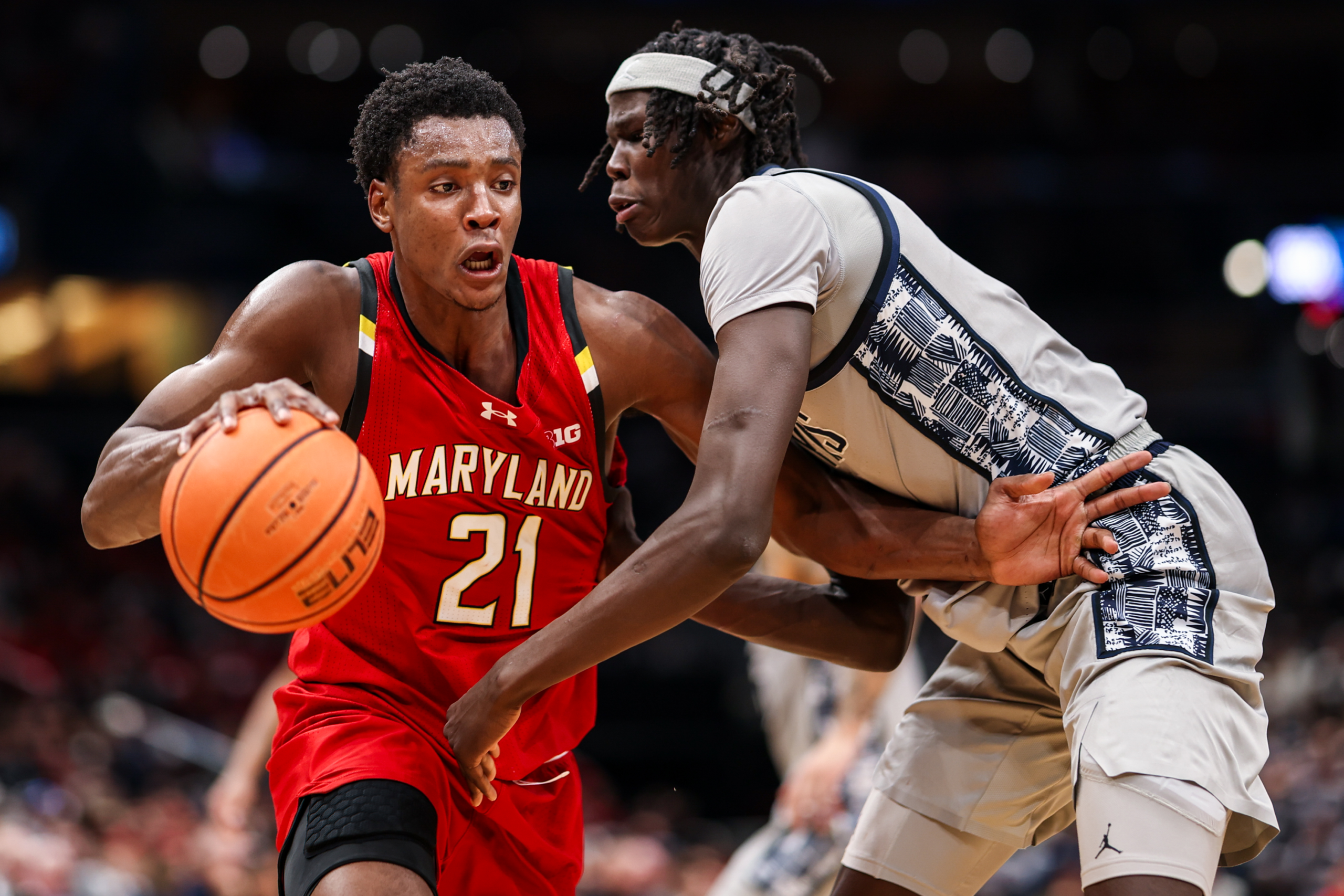
For Maryland forward Pharrel Payne, the difference was evident from the opening minutes.
“I think they punched us in the mouth first, and they hit us with a level of physicality, and we just did not respond,” Payne said.
It was a particularly revealing assessment for a Maryland team built around physicality, rebounding and attacking the basket.
Payne rejected the suggestion that Georgetown had surprised the Terrapins with its approach. The coaching staff had prepared them for what they would encounter, he said. The problem was execution.
“I think our coaches did a pretty good job on the scout and telling us what was going to happen,” Payne said. “We just didn’t play at the level we should have.”
That failure to match Georgetown’s intensity extended beyond any single possession or matchup.
Maryland continued to pursue offensive rebounds, an area Payne identified as one of the team’s foundational priorities. But its overall physicality wasn’t accompanied by the discipline necessary to consistently turn those opportunities into an advantage.
The Terrapins committed 23 fouls, and Georgetown reached the bonus early in the second half, making an already difficult comeback attempt even more challenging.
“We should have played with our chest more and played less with our hands,” Payne said. “That’s something me and the guys have to talk about.”
When offense becomes a defensive problem
Williams offered a more detailed explanation of how Maryland’s offensive struggles contributed to Georgetown’s success on the other end.
The Terps’ inability to consistently create quality shots, he argued, prevented them from establishing the defensive structure necessary to contain Georgetown’s transition attack.
Maryland attempted just one free throw in the first half, a statistic Williams repeatedly referenced as evidence that his team wasn’t applying enough pressure at the rim.
The problem wasn’t necessarily that every missed shot was a bad one. It was that too many attempts came without the offensive organization Williams wants.
“We define shots by medals: gold medal, silver medal, bronze medal, no medal,” Williams explained. “We didn’t have near the gold attempts that you need to have in order to win on the road.”
In Williams’ system, shot quality influences far more than shooting percentage.
Predictable attempts allow teammates to establish offensive rebounding position. Attacks at the rim create opportunities to draw fouls. Made baskets and free throws allow a defense to get organized before the opponent advances the ball.
When those things don’t happen, the consequences can accumulate quickly.
“When you’re shooting unpredictable shots, you’re going to be in a broken floor,” Williams said. “And when you’re in a broken floor, it’s going to lead to fast transition and/or uncontested threes.”
That sequence helped explain Georgetown’s success from beyond the arc.
Rather than treating the Hoyas’ perimeter shooting and Maryland’s offensive struggles as separate problems, Williams viewed them as two sides of the same issue.
“We need our offense to be better so that we can get our defense set,” he said.
Too many fouls, not enough pressure
Maryland’s struggles weren’t limited to its perimeter shooting.
Williams pointed to the disparity in how quickly the teams reached the bonus, particularly after halftime.
Georgetown accumulated fouls against Maryland at a much faster rate early in the second half, limiting the Terrapins’ ability to defend aggressively while trying to erase a double-digit deficit.
“That’s not the way that you want to start,” Williams said. “We want to make more free throws than the opponent attempts, and so we have to defend without fouling.”
The coach was particularly critical of what he described as too many reaching fouls.
At the other end, Maryland’s inability to consistently attack the basket made it difficult to put Georgetown under the same pressure.
“I don’t think we can only shoot one free throw and have a chance, whether we play at home or on the road,” Williams said.
Even as the Terrapins improved their offensive rebounding and shot selection after halftime, their earlier mistakes had already created a difficult situation.
For a team whose identity is supposed to revolve around physicality and relentless pressure, the inability to dictate those terms was especially troubling.
Williams sees promise in House
There were individual performances that offered Williams some encouragement.
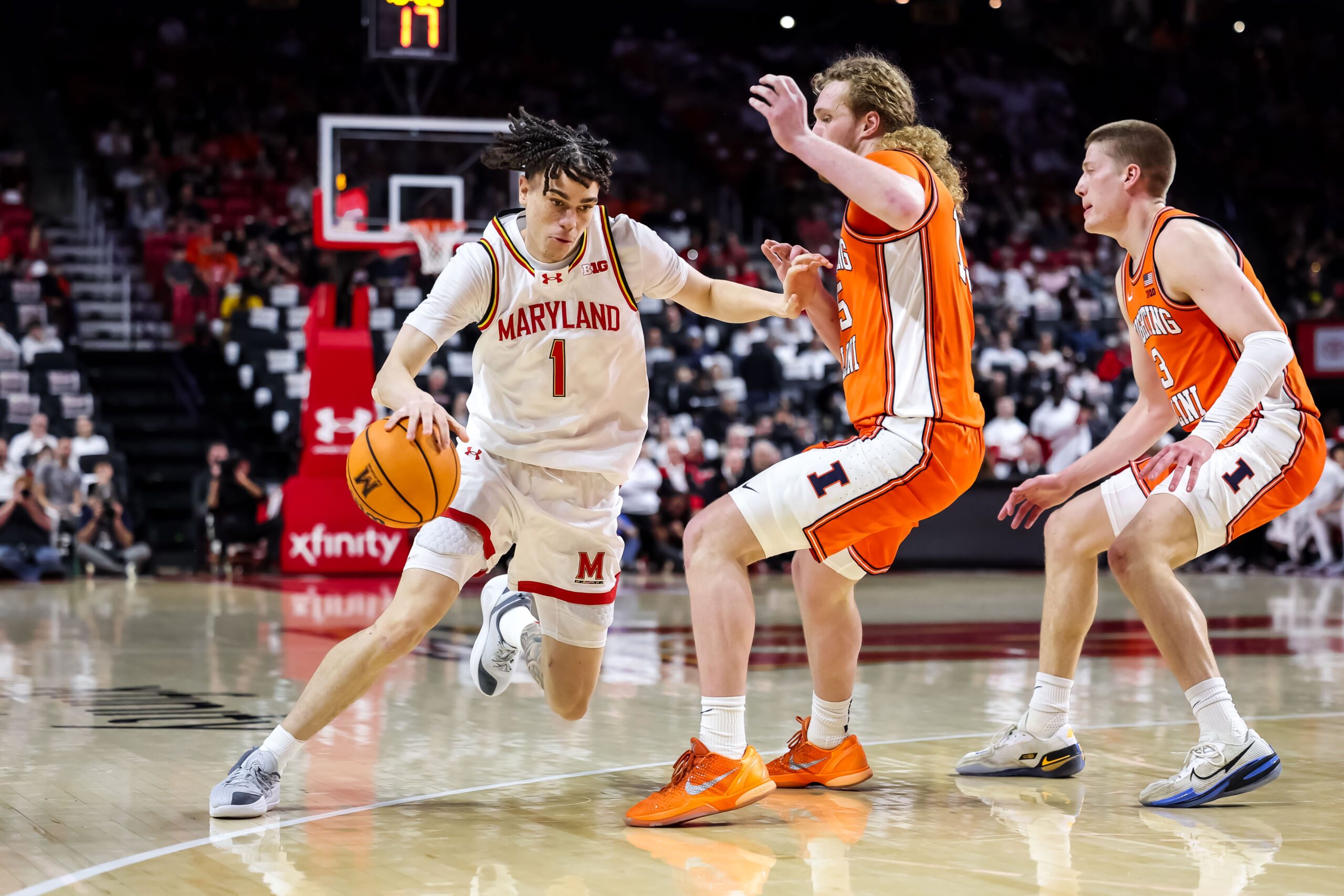
Freshman guard Kaden House reached double figures for the second consecutive game, continuing an encouraging start to his college career.
Williams was particularly complimentary of House’s defensive toughness and willingness to compete, even while acknowledging the areas where the freshman remains a work in progress.
“I really like what he is defensively,” Williams said. “I really like the toughness that he competes with.”
House’s aggression can occasionally work against him, Williams explained, taking him out of defensive position. Offensively, he’s still learning how to use spacing to create more opportunities to draw fouls.
But the coach made clear that he believes House can become an important part of Maryland’s future.
“I’m excited about his future, and I think that he fits us on both sides of the ball in a really good way,” Williams said.
A lesson in responding to adversity
For Williams, the most significant takeaway from Saturday’s loss may not emerge until Maryland returns to practice.
He explained that he deliberately avoids lengthy postgame speeches, preferring to review film before making definitive assessments.
The approach allows him to separate emotional reactions from conclusions supported by evidence.
“I don’t talk much postgame, ever, good win or bad loss, because I like to watch it so that the words I use have evidence to support them,” Williams said.
He expects the coming film sessions to reveal numerous lessons rather than one easily identifiable cause.
“It’s not one thing,” Williams said. “It’s multiple things, because multiple things are required to win. Multiple things contribute to losing.”
The Terrapins, he said, have consistently responded to instruction throughout the summer and preseason. Now they face a different challenge: responding to their first regular-season setback.
Williams identified physicality, communication, decision-making and the ability to recognize the right offensive action as areas requiring improvement.
He also made clear that the responsibility extends beyond the players.
“I don’t think that’s specific to one person,” Williams said. “I think that’s specific to the entire operation. That includes me.”
Maryland’s performance against Georgetown offered a reminder that the identity Williams is attempting to establish remains a work in progress.
The Terrapins have shown they can compete physically and attack the offensive glass. But Saturday demonstrated how quickly those strengths can be undermined when shot selection, defensive discipline and communication break down.
Williams has repeatedly emphasized that his objective is to develop a team capable of playing its best basketball months from now, not necessarily during the opening week of November.
The Georgetown loss provided an early measuring stick for how far Maryland still has to go.
“From a physicality standpoint, we weren’t there,” Williams said. “From a communication standpoint, we weren’t there. From an aggressiveness standpoint, with a high IQ on what’s right relative to time, score and momentum, we weren’t there.”
For Williams, the next step is making sure those failures become teaching points rather than recurring problems.
“It’s a great opportunity for us to teach from and for them to learn from,” he said, “because it’s going to be required over the next 19 weeks.”