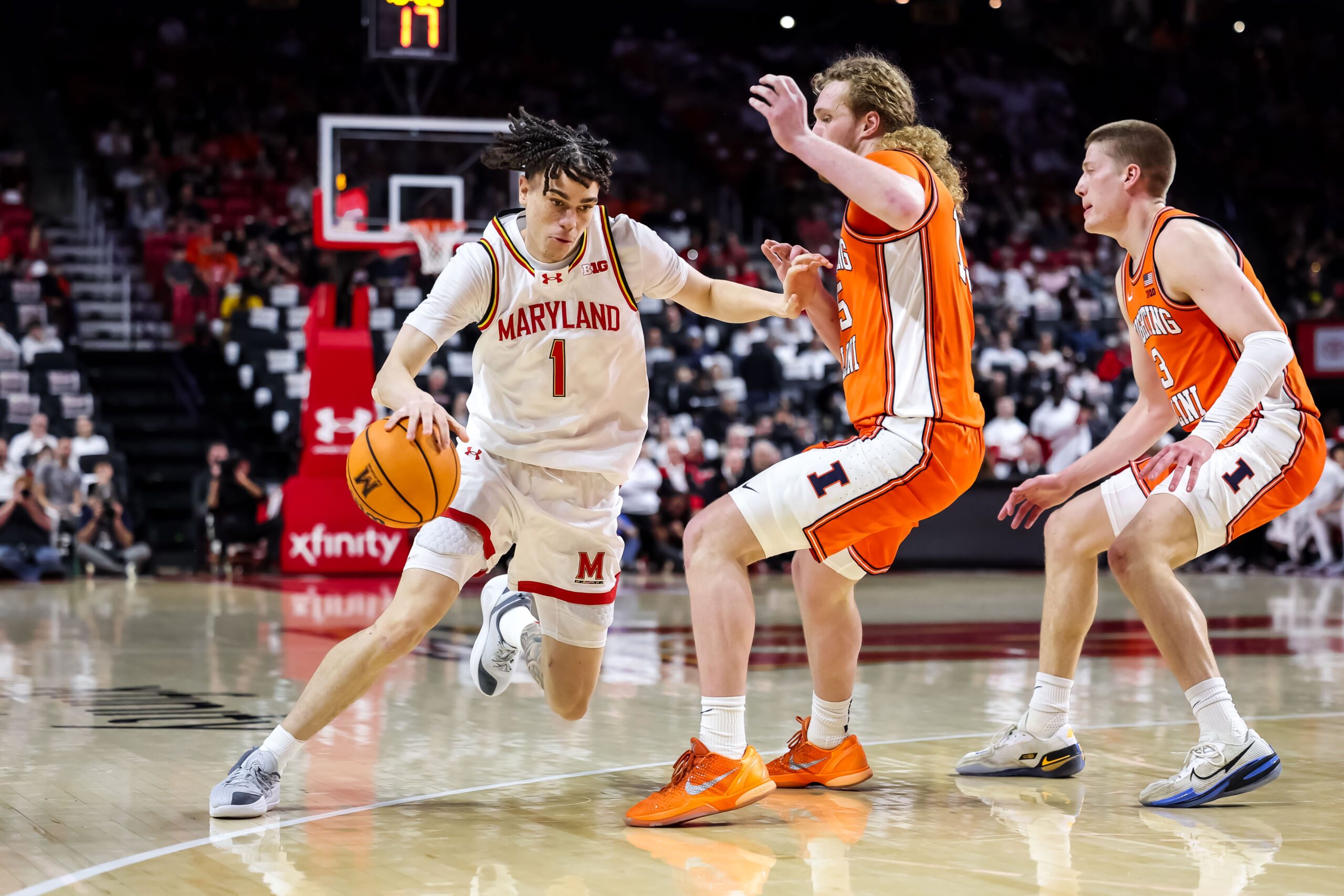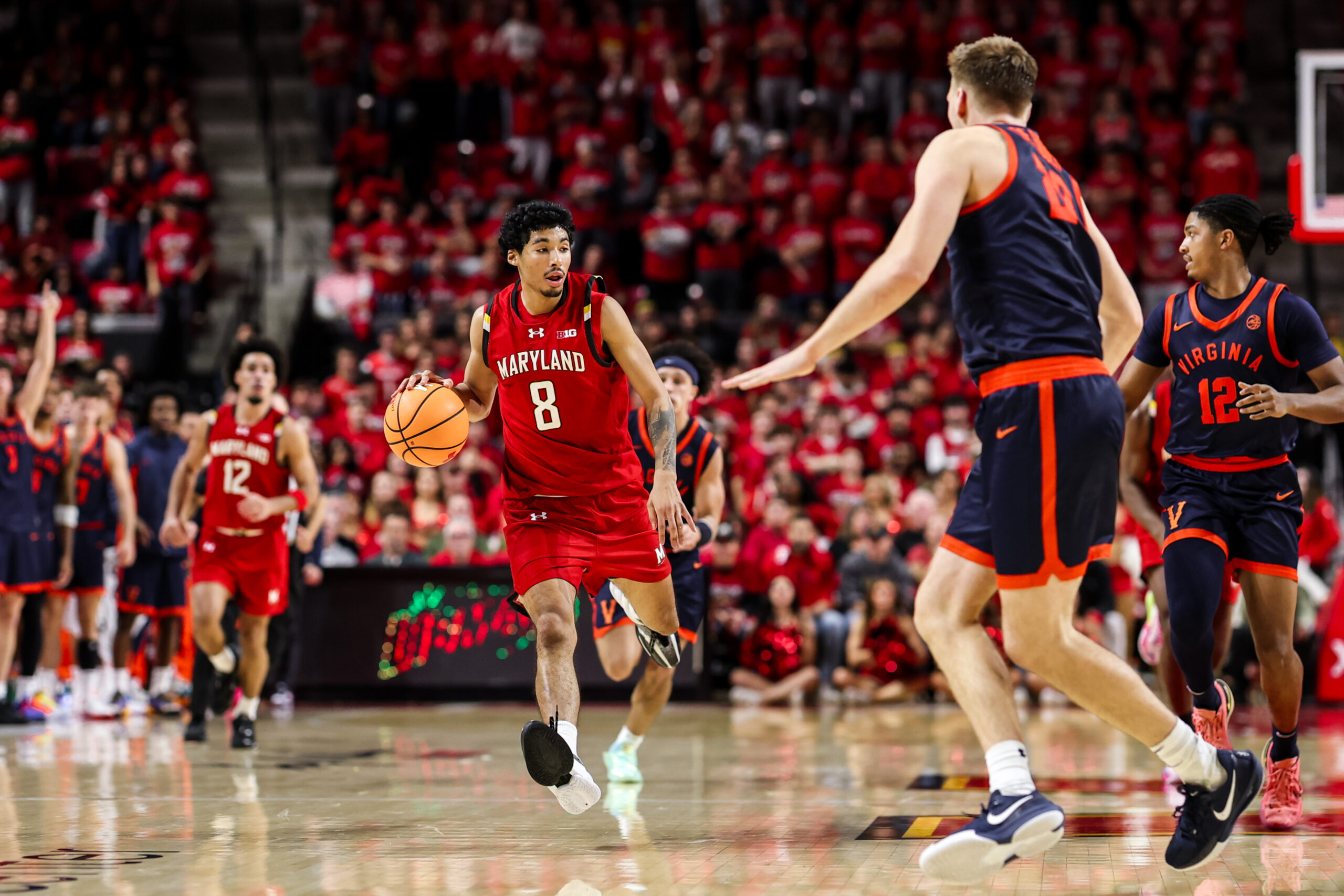

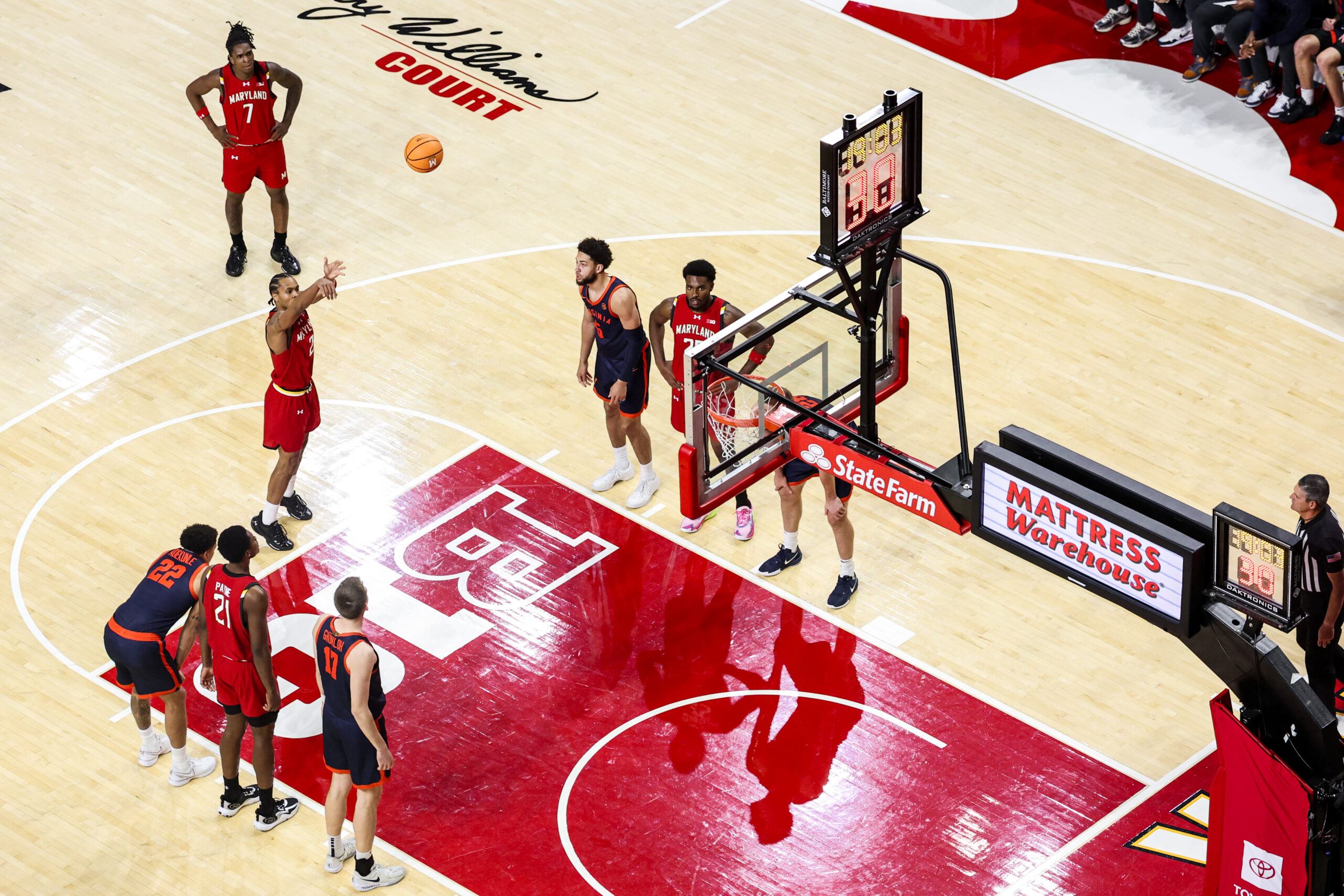
For 20 minutes Friday night, Maryland looked like a team capable of knocking off one of the nation’s best.
The Terrapins were physical, aggressive and disruptive. They took No. 6 Virginia out of its offensive rhythm, forced turnovers and repeatedly attacked the basket. By halftime, Maryland had built an 11-point lead, and a raucous XFINITY Center crowd could sense an upset in the making.
Then Virginia adjusted.


The Cavaliers abandoned much of the perimeter-oriented approach that had defined their early-season offense, attacked the openings in Maryland’s defense and shot a staggering 76.9 percent in the second half. The result was an 87-83 Virginia victory that left Maryland with another frustrating loss — and a revealing lesson about what it takes to beat an elite opponent.
For Maryland coach Buzz Williams, the disappointment wasn’t necessarily that his team’s game plan failed. It was that the Terrapins couldn’t sustain the execution required to make it work for 40 minutes.
“We did not have the physical, mental, emotional stamina, endurance from start to finish that’s required to beat a top-five team,” Williams said afterward.
Virginia coach Ryan Odom offered a similar assessment from the winning locker room.
“Maryland’s basketball team, they played extremely well,” Odom said. “They put a ton of pressure on us in the first half to respond. We had no other choice but to respond appropriately after halftime.”
Maryland dictated the first half
Virginia arrived in College Park having attempted nearly half its shots from three-point range through its first four games, connecting on better than 40 percent of those attempts.
Williams and his staff built their defensive approach around taking away those opportunities.
The Terrapins extended their defense toward Virginia’s perimeter shooters, challenged passing lanes and used their physicality to disrupt the Cavaliers’ offensive flow.
The strategy worked.
Virginia attempted just five three-pointers in the opening half, making one. Maryland forced the Cavaliers into difficult possessions and took advantage of their mistakes.
At the other end, the Terrapins relentlessly attacked the basket, drawing fouls and creating second-chance opportunities.
Maryland went into halftime leading 47-36, having established the physical tone Williams wanted.
“I do think defensively our plan was spot on,” Williams said. “Through four games, 49 percent of their shots had been from three, and they were shooting over 40 percent from three.”
Odom acknowledged that Maryland’s approach had disrupted Virginia’s offense.
“Maryland made us not necessarily play like ourselves in the first half, and I thought they did an excellent job,” Odom said. “Great game plan.”
Virginia guard Sam Lewis, who finished with a game-high 28 points, was even more direct about the impact of Maryland’s physicality.
“It rattled us a little bit in the first half,” Lewis said. “But in the second half, we regrouped and came out with a fight.”
For a Maryland team coming off a disappointing loss at Georgetown, the first half represented a significant response.
Williams saw the same thing.
“I think we’ve had an incredible response to a disappointing result,” he said. “The entire organization responded in a great way.”
Virginia found the openings
The problem for Maryland was that its defensive strategy came with a trade-off.
By extending toward Virginia’s perimeter shooters, the Terrapins were leaving more space around the basket. For much of the first half, their physicality and defensive positioning compensated for that vulnerability.
In the second half, Virginia exploited it.
The Cavaliers began attacking the paint with greater purpose, using Lewis and Thijs De Ridder to create driving opportunities and force Maryland’s defenders into difficult decisions.
Virginia made 20 of its 26 second-half field-goal attempts, scoring 51 points after intermission.
The Cavaliers finished with 58 points in the paint, an extraordinary total for a team that entered the night relying heavily on three-point shooting.
“They obviously were locking out on us, and so we had to adjust in the second half and get to the basket,” Odom said. “We were able to free that up a little bit where guys had more direct lines to the basket.”
Lewis was particularly effective, scoring 28 points on 12-of-16 shooting without making a three-pointer.
“I just came and played in the flow of the game,” Lewis said. “Whatever they gave me, I took. The three shot wasn’t falling, so I was taking it to the basket, and that was what was open.”
De Ridder added 20 points on 8-of-13 shooting, while Johann Grünloh contributed 15 points and seven rebounds.
The Cavaliers attempted only 10 three-pointers all night, but they no longer needed their usual perimeter volume.
“We want a balance, there’s no question about it,” Odom said. “But when you get 58 points in the paint, a coach is not going to complain about that.”
Williams recognized the problem and eventually adjusted Maryland’s defensive approach to provide more protection around the rim.
“We did make an adjustment to have more presence at the rim because they were scoring at such a high rate,” Williams said. “They were scoring twos. They weren’t scoring threes. But they were scoring twos at the rim, and we were fouling too much in the second half.”
By then, Virginia had found an offensive rhythm Maryland struggled to disrupt.
Offensive execution became a defensive problem
Williams believes Maryland’s second-half defensive struggles were connected to what happened at the other end of the floor.
The Terrapins scored 47 points in the first half but managed just 36 after halftime, shooting 11-of-29 from the field over the final 20 minutes.
Maryland also committed seven second-half turnovers after giving the ball away just three times before intermission.
Williams repeatedly returned to the importance of shot quality, explaining that poor offensive possessions can make it harder for his team to establish its defense.
“Our shot quality impacts our free throw attempt rate. Our shot quality impacts our offensive rebound percentage,” Williams said. “But it also impacts the opponent’s shot quality.”
Maryland finished with 31 made free throws on 39 attempts, an indication of how effectively it attacked Virginia’s defense.
Pharrel Payne led the Terrapins with 20 points, making eight of his 10 free-throw attempts. Kaden House added 17 points, including nine free throws, while Mike McNair Jr. contributed 15 points and three three-pointers.

But the offensive opportunities that fueled Maryland’s first-half success became harder to generate.
Williams said the Terrapins recovered nearly half of their missed shots in the first half, compared with approximately 11 percent after halftime.
As Maryland’s offensive efficiency declined, Virginia increasingly found itself attacking before the Terrapins could establish their preferred defensive positioning.
“If you’re taking a bad shot and they’re zooming it up the floor, you may be able to slow down their threes, but you don’t get hat on hat and get your defense set,” Williams explained.
The result was a cascading problem: Maryland’s offensive struggles helped create Virginia’s transition and driving opportunities, which in turn made it harder for the Terrapins to maintain the physical defensive approach that had worked so well early.
A lesson in sustaining the effort
Maryland’s players recognized that the second-half breakdown wasn’t simply about Virginia making adjustments.
McNair believed the Terrapins became less disciplined as the game progressed.
“I feel like we kind of just got complacent as a team, and we let foul calls get us to be a little bit less aggressive,” McNair said. “When things wouldn’t go our way as a group, we wouldn’t focus on the details that we were talking about.”
House, despite producing his best scoring performance in a Maryland uniform, was equally critical of his own play.
“I think I could’ve had a better performance,” House said. “I gave up two offensive rebounds, and I got too deep in the paint a few times. I needed to play off two a lot more.”
Williams praised House’s competitiveness and potential.
“As I’ve told you guys, he’s an outlier,” Williams said. “He’s an outlier in how he thinks. He’s an outlier in how he competes. I thought he was tremendous.”
Still, individual performances weren’t enough to overcome Virginia’s second-half efficiency.
Odom credited his team’s experience and willingness to make adjustments rather than abandoning its approach when things went wrong.
“These guys have been in some battles,” Odom said. “Today, the pressure was on us to play better if we were going to have a chance to win and play more like ourselves.”
That experience showed as the Cavaliers gradually erased Maryland’s lead and took control late.
For Williams, the difference came down to the ability to execute through adversity.
“When you’re playing a game of this magnitude, you have no margin,” Williams said. “You could almost say you have a negative margin. When you have empty possessions or average possessions, average is not enough.”
A missed opportunity in front of a memorable crowd
The loss was particularly painful given the atmosphere inside XFINITY Center.
Maryland’s first-half performance energized a crowd that had been waiting for an opportunity to celebrate a signature victory.
Williams described the environment in glowing terms afterward, suggesting it was the best he had experienced as a head coach.
“It’s unbelievable,” Williams said. “I thought the ambiance pregame, you could already sense it.”
House and McNair both acknowledged the crowd’s impact.
“They were really into the game,” House said. “It just sucks that we couldn’t get them a win.”
For Maryland, the result was another disappointing finish, but one that offered a clearer picture of both the team’s potential and its shortcomings.
The Terrapins demonstrated they could disrupt a nationally ranked opponent, impose their physical style and execute a game plan well enough to build a double-digit lead.
What they couldn’t do was sustain it.
Virginia had the experience, offensive versatility and second-half answers to turn the game around.
Maryland is still searching for the consistency to prevent that from happening.
Williams believes those lessons must be learned not just during games, but in every aspect of the program’s preparation.
“You can’t just wait till game day to do it,” Williams said. “You have to do it every day.”
After two consecutive losses to Georgetown and Virginia, Maryland has plenty to learn from.
But Friday night also offered something encouraging: For one half against one of the nation’s best teams, the Terrapins showed what they might become.
Now comes the harder part — doing it for 40 minutes.