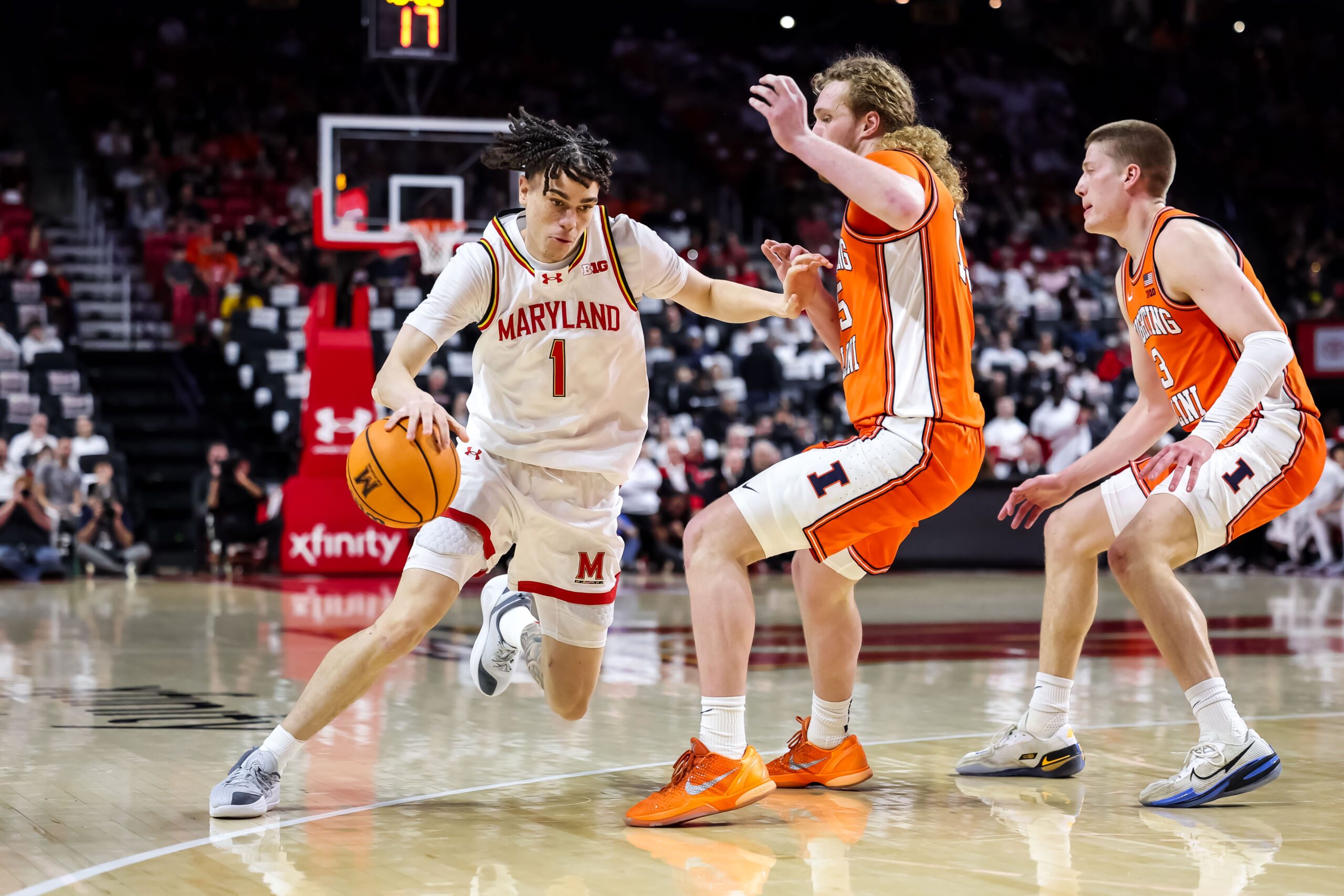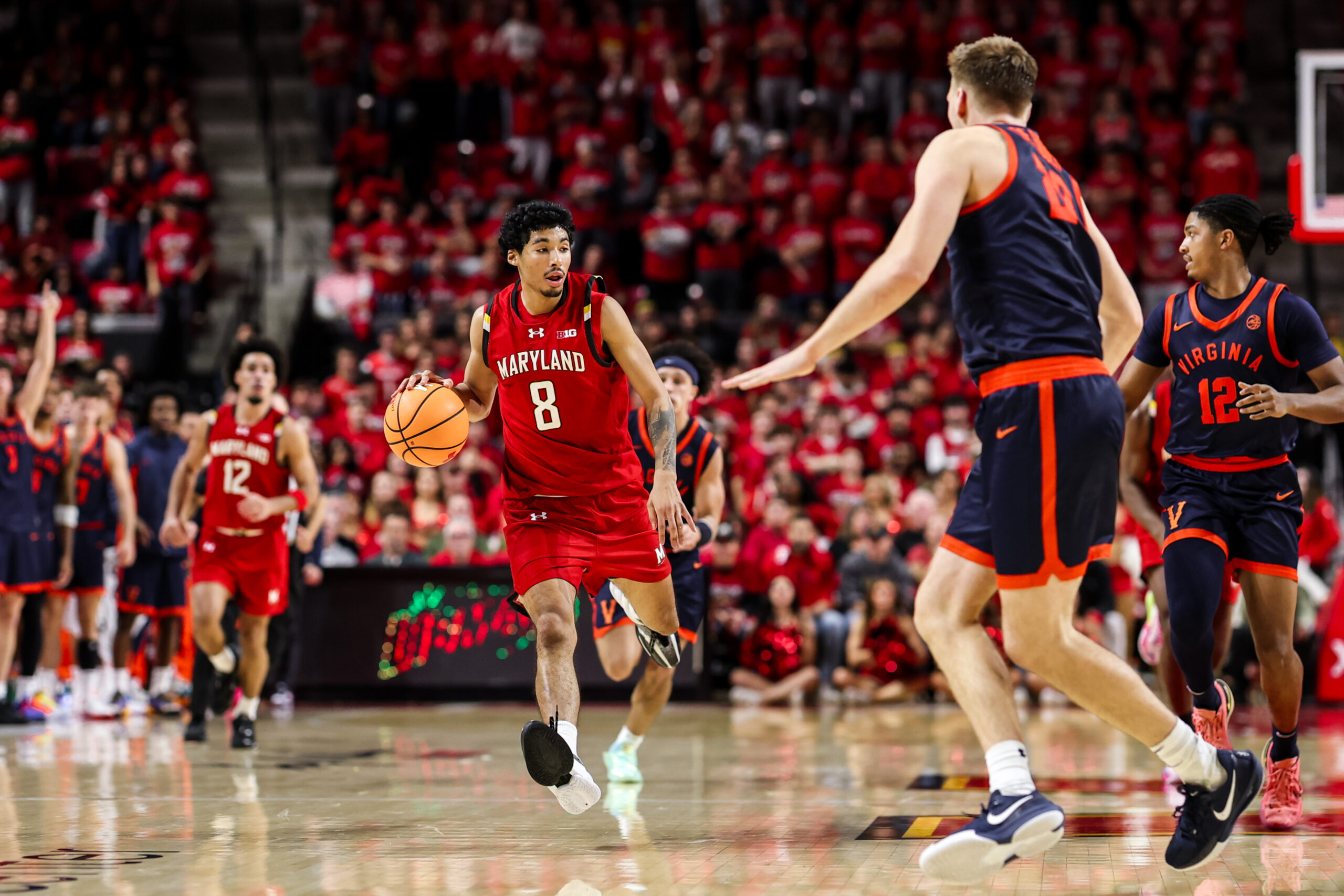


Maryland faces its toughest test of the young season Friday night when Virginia visits Xfinity Center in a matchup of former ACC rivals.
The Terrapins (1-1) are looking to bounce back from an 86-74 loss at Georgetown, a game in which their perimeter shooting struggles and defensive breakdowns overshadowed an otherwise productive night on the offensive glass.
Virginia (4-0), meanwhile, has been one of the nation’s more impressive teams through the opening two weeks. The Cavaliers have won their first four games by an average of 28 points and enter Friday’s contest ranked No. 6 in the latest AP poll.
For Maryland, the matchup represents an opportunity to earn an early signature victory and demonstrate progress against a nationally ranked opponent. It also offers another important measuring stick for a roster still working to establish its identity under second-year coach Buzz Williams.


TV: Peacock/NBCSN, John Fanta (Play-by-Play), Nick Fahe (Analyst)
Radio: Johnny Holliday (Play-By-Play), Chris Knocke (Analyst)
All-time series: Maryland leads 108-77
Last meeting: Virginia 80, Maryland 72 on December 20, 2025, in Charlottesville, VA
Meet the Cavaliers
Ryan Odom has Virginia playing efficient, balanced basketball early in his second season in Charlottesville.
The Cavaliers enter Friday’s matchup with victories over Drexel, Northeastern, Arkansas and Bucknell. They’ve scored at least 89 points in all four contests and have held three of their four opponents to 61 points or fewer.
Perhaps most impressive is the efficiency with which Virginia has generated its offense.
The Cavaliers rank among the nation’s better offensive teams, with an adjusted offensive efficiency of 121.1 points per 100 possessions, according to KenPom. Their 58.1 effective field goal percentage reflects a team that has consistently generated quality looks from both inside and beyond the arc.
Virginia is shooting 36.2 percent from three-point range and 61.4 percent on two-point attempts. The Cavaliers have also been effective at protecting the basketball, turning it over on just 16.9 percent of their possessions.
Unlike the deliberate, methodical Virginia teams that became synonymous with Tony Bennett’s tenure, Odom’s Cavaliers are comfortable playing at a faster pace. Their adjusted tempo of 71.1 possessions per 40 minutes is slightly above the national average and higher than Maryland’s 70.3.
Virginia’s offensive attack is led by Thijs De Ridder, a 6-foot-9 forward who has emerged as one of the Cavaliers’ most important players.
De Ridder has been highly efficient around the basket, shooting 63.6 percent on two-point attempts while also connecting on 57.1 percent of his three-point opportunities through four games. His ability to score from multiple areas of the floor presents a difficult matchup for opposing frontcourts.
Sophomore guard Chance Mallory has also made an immediate impact. The 5-foot-10 playmaker has started all four games and leads Virginia in offensive involvement, using more than 23 percent of the team’s possessions while on the floor.
Mallory’s quickness and ability to create opportunities for teammates make him a central piece of Virginia’s offense. His 30.3 assist rate is the highest among the Cavaliers’ primary contributors.
Virginia also features Sam Lewis, a 6-foot-7 wing who provides perimeter shooting and additional offensive versatility. Lewis has connected on 40.9 percent of his three-point attempts and is another player Maryland cannot afford to leave open.
Johann Grünloh gives the Cavaliers size and rim protection in the frontcourt. The 7-footer has been particularly disruptive defensively, posting a 13.2 percent block rate while helping Virginia limit opponents to 48.7 percent effective shooting.
That defensive presence is part of a larger strength for the Cavaliers.
Virginia ranks No. 15 nationally in adjusted defensive efficiency at 93.5 points allowed per 100 possessions. Opponents have struggled to generate efficient looks inside the arc, shooting just 49.2 percent on two-point attempts.
The Cavaliers have also done a respectable job on the defensive glass, allowing opponents to rebound 26.6 percent of their missed shots.
One potential area of vulnerability has been defending the perimeter. Virginia’s opponents have connected on 32 percent of their three-point attempts, although the Cavaliers have generally compensated with strong interior defense and an ability to force turnovers.
Maryland will need to find ways to exploit those opportunities while avoiding the offensive stagnation that plagued the Terps against Georgetown.
By the Numbers
| 62 | KenPom Rank | 10 |
| 1-1 | Record | 4-0 |
| 115.1 | Adjusted Off. Efficiency | 121.1 |
| 101.0 | Adjusted Def. Efficiency | 93.5 |
| 70.3 | Adjusted Tempo | 71.1 |
| 48.1% | Effective FG% | 58.1% |
| 19.2% | Turnover % | 16.9% |
| 58.8% | Off. Rebound % | 43.1% |
| 40.7% | FTA/FGA | 27.9% |
| 20.8% | 3-Point % | 36.2% |
Three keys to the game
1. Maryland must find its perimeter shooting.
The Terps’ three-point shooting has been a major concern through their first two games.
Maryland is connecting on just 20.8 percent of its attempts from beyond the arc, a figure that ranks among the worst in Division I. The struggles were especially apparent against Georgetown, when the Terps made just 15 percent of their three-point attempts.
Virginia presents an even more difficult defensive challenge, particularly around the basket.
The Cavaliers have the size and rim protection to make scoring inside difficult, meaning Maryland will need to convert enough perimeter opportunities to prevent Virginia from packing the paint.
That doesn’t necessarily mean taking more threes. It means generating better ones.
The Terps need to move the basketball, create advantages off penetration and avoid settling for contested attempts early in possessions.
If Maryland continues shooting at its current rate, Virginia’s defense will have a significant advantage.
2. Dominate the offensive glass — and finish defensive possessions.
Maryland’s biggest statistical advantage entering Friday’s game is its offensive rebounding.
The Terps lead the nation with an extraordinary 58.8 offensive rebounding percentage, according to KenPom. That means Maryland has recovered nearly six out of every 10 available offensive rebounds through its first two games.
It’s an unsustainable pace over a full season, but it demonstrates the aggressive approach Williams has emphasized.
Virginia has also been excellent on the offensive glass, collecting 43.1 percent of its available misses.
That sets up a potentially decisive battle for second-chance opportunities.
For Maryland, offensive rebounds could help compensate for its perimeter shooting struggles by creating additional possessions and high-percentage looks near the basket.
But the Terps must also improve their defensive rebounding.
Maryland has allowed opponents to recover 26.7 percent of their misses, and Virginia’s frontcourt will present a much more significant challenge than most early-season opponents.
Whichever team can consistently finish defensive possessions and capitalize on second chances will have an important advantage.
3. Take care of the basketball.
Virginia’s offensive efficiency isn’t simply the product of good shooting. The Cavaliers have also done an effective job limiting mistakes.
Virginia’s turnover rate sits at 16.9 percent, compared with Maryland’s 19.2 percent.
That difference may not appear dramatic, but against a quality opponent, two or three additional possessions can determine the outcome.
Maryland has been especially vulnerable to empty trips when its offense becomes stagnant or players attempt to create individually rather than working within the flow of the possession.
Virginia’s defense will test the Terps’ ability to make quick decisions, recognize help defenders and execute against an organized opponent.
The Cavaliers force turnovers on 24.5 percent of their opponents’ possessions, another indication of how disruptive their defense has been.
Maryland cannot afford to give Virginia additional scoring opportunities through careless passes or poor decisions.
The Terps will need to value each possession, particularly if the game remains close in the final minutes.
What it comes down to
Virginia enters Friday’s matchup as the more complete team.
The Cavaliers have been substantially more efficient offensively, considerably better defensively and far more consistent shooting the basketball.
They also have the advantage of an established rotation and a roster that has quickly developed chemistry.
Maryland, on the other hand, remains a work in progress.
The Terps have shown they can generate extra possessions through offensive rebounding, and their ability to get to the free-throw line could be another important factor. Maryland’s free-throw rate of 40.7 attempts per 100 field goal attempts is significantly higher than Virginia’s 27.9.
But those advantages will mean little if the Terps continue struggling from three-point range or allow Virginia to dictate the game offensively.
The matchup could ultimately hinge on Maryland’s ability to turn its rebounding advantage into efficient scoring opportunities while limiting Virginia’s perimeter attack.
KenPom projects an 80-74 Virginia victory, giving the Cavaliers a 71 percent chance of winning.
For Maryland to pull the upset, the Terps will need their best shooting performance of the young season, another dominant effort on the offensive glass and a considerably cleaner defensive performance than they produced against Georgetown.
The opportunity is there. Whether Maryland is ready to capitalize on it remains to be seen.