
Interim head coach Aazaar Abdul-Rahim has simplified the playbook, emphasized fundamentals and introduced a more aggressive defensive philosophy as the Terrapins prepare for Saturday’s matchup at Purdue.
Maryland didn’t get the result it wanted in Aazaar Abdul-Rahim’s first game as interim head coach, but the Terrapins believe the changes taking place inside the program are beginning to make a difference.
A week after pushing Illinois to the final seconds of a 20-17 loss, Maryland travels to Purdue on Saturday looking to end a six-game losing streak and secure its first Big Ten victory of the season.
The Terps are running out of opportunities to salvage a difficult year. At 2-6 overall and 0-5 in conference play, Maryland must win its final four games to become bowl eligible. But Abdul-Rahim’s immediate priority has been less about the standings and more about changing how his team prepares, practices and competes.
That approach has included simplifying the offensive and defensive playbooks, placing greater emphasis on situational football and reinforcing the fundamentals that Abdul-Rahim believes should define the program.
During his weekly press conference, Abdul-Rahim emphasized the importance of returning to the team’s core principles, eliminating unnecessary complexity and concentrating on the fundamentals that give Maryland its best chance to succeed.
For linebacker Daniel Wingate, one of Maryland’s most experienced defensive players, the differences have been noticeable. Wingate described a more physical defensive approach under Abdul-Rahim, with additional pressure, more man-to-man coverage and a greater emphasis on challenging opposing receivers.
Those changes were evident against Illinois, when Maryland held the Fighting Illini to 10 points through three quarters and carried a 14-10 lead into the fourth.
The Terps ultimately surrendered a 64-yard touchdown run early in the final period and allowed Illinois to drive for a game-winning field goal as time expired. Still, the performance represented a more competitive effort than Maryland had produced in several of its previous conference losses.
For Abdul-Rahim, the challenge now is making that effort consistent enough to produce victories.
Simplifying the message
One of Abdul-Rahim’s first priorities after taking over the program was reducing unnecessary complexity, both on and off the field.
Rather than overloading players with information, the interim coach has shortened practices, condensed the offensive and defensive playbooks and placed greater emphasis on situational football.
The changes are designed to allow players to execute their assignments with greater confidence instead of spending valuable time thinking through an extensive collection of plays.
“He’s been able to change practice to where we’ve had to focus on more situational aspects instead of just going through the motions,” Wingate said.
“Really understanding what we’re supposed to do in a situation, how we’re supposed to play these situations, and preparing for it for when we approach it within the game.”
Abdul-Rahim has also attempted to create a more relaxed atmosphere around the program, encouraging players to be comfortable and enjoy playing football rather than allowing the pressure of a disappointing season to consume them.
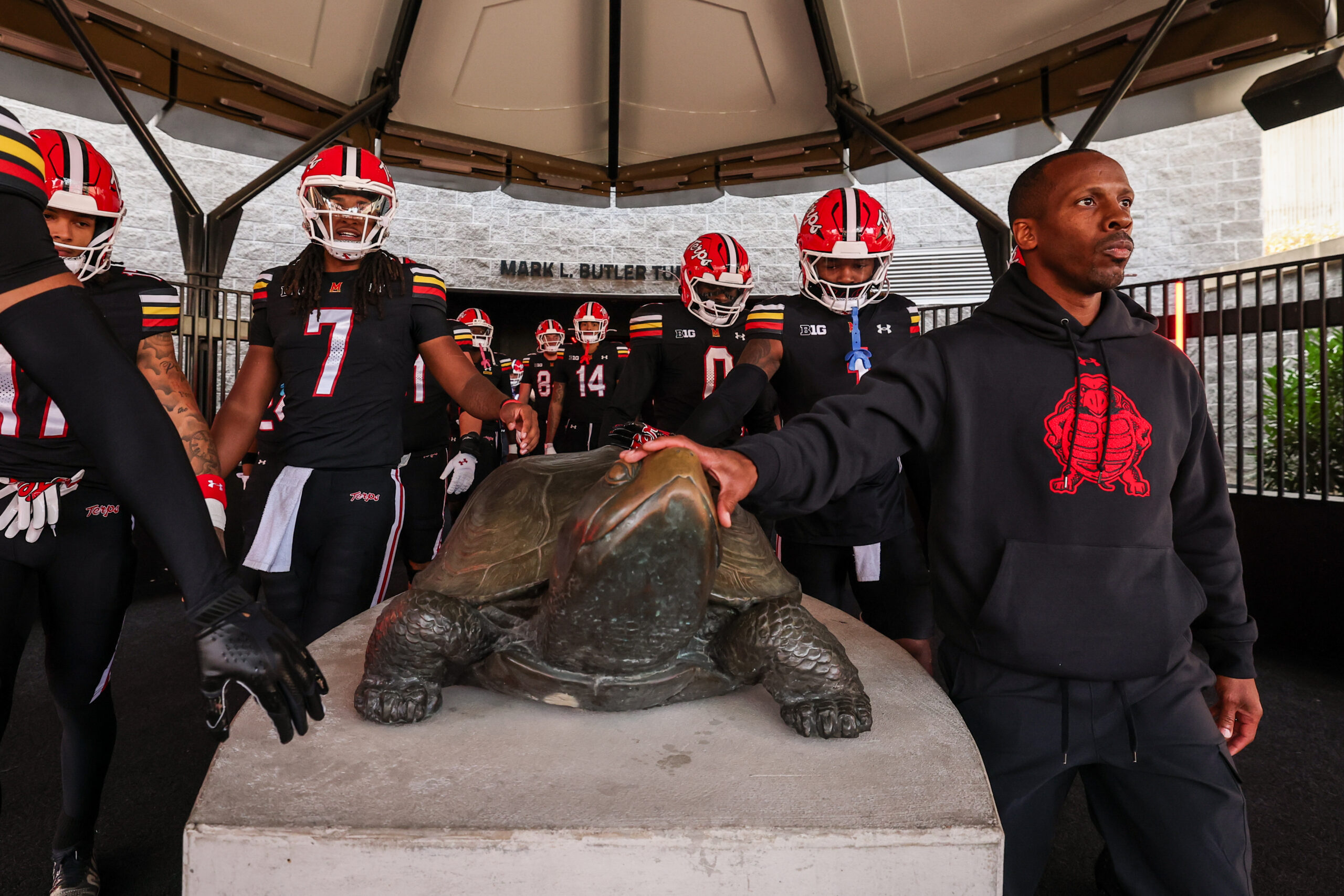
One of the more visible changes came before the Illinois game, when Maryland players traded their traditional suits for sweatsuits during their walk down Terp Alley to SECU Stadium.
The decision was a small but symbolic departure from the previous routine, reflecting Abdul-Rahim’s desire to eliminate unnecessary distractions.
“Letting us be a little more loose, being more comfortable instead of just being all uptight and so worried about the game,” Wingate said.
The more relaxed environment hasn’t meant lowering expectations. Instead, Abdul-Rahim has sought to balance greater freedom away from the field with more demanding preparation on it.
Wingate believes the changes have already translated into improved competitiveness.
“He’s kind of emphasized the fact that we need to be more competitive in our situational battles and just being able to win those situational things,” Wingate said.
“It kind of showed up last Saturday, but we can be better, and we will be better, and we’ll work on it this week.”
A more aggressive defensive identity
Abdul-Rahim’s background on the defensive side of the ball has also influenced Maryland’s approach.
The adjustments have extended beyond scheme.
Abdul-Rahim said the coaching staff reevaluated personnel and developed packages designed to put its most effective players on the field in critical situations.
The emphasis has been on matching personnel to specific circumstances while allowing players to execute their responsibilities without hesitation.
But the interim coach has also made clear that schematic adjustments alone won’t determine whether Maryland can finish games. He has repeatedly stressed that sound tackling and proper execution remain essential, regardless of the defensive call.
That fundamental issue was particularly costly against Illinois.
Maryland’s defense surrendered 184 rushing yards, including the 64-yard touchdown run by Javari Barnett on the opening play of the fourth quarter. Abdul-Rahim characterized the breakdown as a missed run fit, the kind of assignment error that can undermine an otherwise competitive defensive performance.
The Terps also allowed Illinois to move 67 yards on its final possession before Ethan Moczulski connected on a 26-yard field goal as time expired.
Maryland has shown it can compete defensively for extended stretches. The next step is eliminating the mistakes that have repeatedly turned competitive games into losses.
Violence, technique and effort
At the center of Abdul-Rahim’s defensive approach is a three-part philosophy known as VTE: violence, technique and effort.
The message emphasizes physical, aggressive football, disciplined execution and maximum effort on every snap. Although the philosophy originated on the defensive side of the ball, Abdul-Rahim has begun extending its principles throughout the program.
“He’s come to our team meetings and started off with VTE,” Wingate said. “Being able to preach that from a defensive aspect and really bringing it into a whole-team aspect has been really good for us.”
For Wingate, the philosophy has translated into a noticeable change in Maryland’s defensive approach.
“The difference has been a more physical approach,” Wingate said. “More at you, send a little more pressure, play a little more man, and just being a little tighter in coverage.”
The emphasis extends beyond aggressive play-calling. Abdul-Rahim wants players to understand their assignments, execute proper technique and maintain their effort even when a play doesn’t unfold as intended.
“Even if you are wrong, just having effort at the end of the day to complete the job,” Wingate said.
The approach also places a premium on attention to detail, something Wingate said Abdul-Rahim continually reinforces during practices, meetings and games.
“He’s kind of emphasized about how we just need to be so focused on the details of what we’re doing and of our job,” Wingate said.
For a Maryland defense that has struggled with missed assignments and costly breakdowns throughout the season, the objective is to turn those principles into more consistent execution.
The challenge now is sustaining that physicality, discipline and effort for four quarters, something the Terrapins will need to do if they hope to turn improved competitiveness into victories.
Four games, one opportunity at a time
Saturday’s trip to West Lafayette begins a four-game stretch that will determine whether Maryland can extend its season beyond November.
The Terps must win out to reach the six victories required for bowl eligibility, a difficult assignment for a team still searching for its first conference win.
Wingate, however, insisted the players aren’t allowing that possibility to become an additional burden.
“No, it’s not a lot of pressure,” he said. “We still want to approach every week with the same mindset to just become 1-0.”
“We’re not worried about any other games in the future. We’re just worried about today and what we have to focus on and what our job is to win the day.”
That philosophy will be tested against a Purdue team looking to build momentum under second-year coach Barry Odom.
Maryland’s immediate objective is straightforward: sustain the competitiveness it displayed against Illinois, execute more consistently in critical situations and avoid the mistakes that have cost it opportunities throughout the season.
For Abdul-Rahim, Saturday offers another chance to demonstrate that the changes being implemented can produce something more meaningful than an encouraging performance.
And for Wingate and his teammates, it represents an opportunity to turn a renewed sense of purpose into a long-awaited victory.