

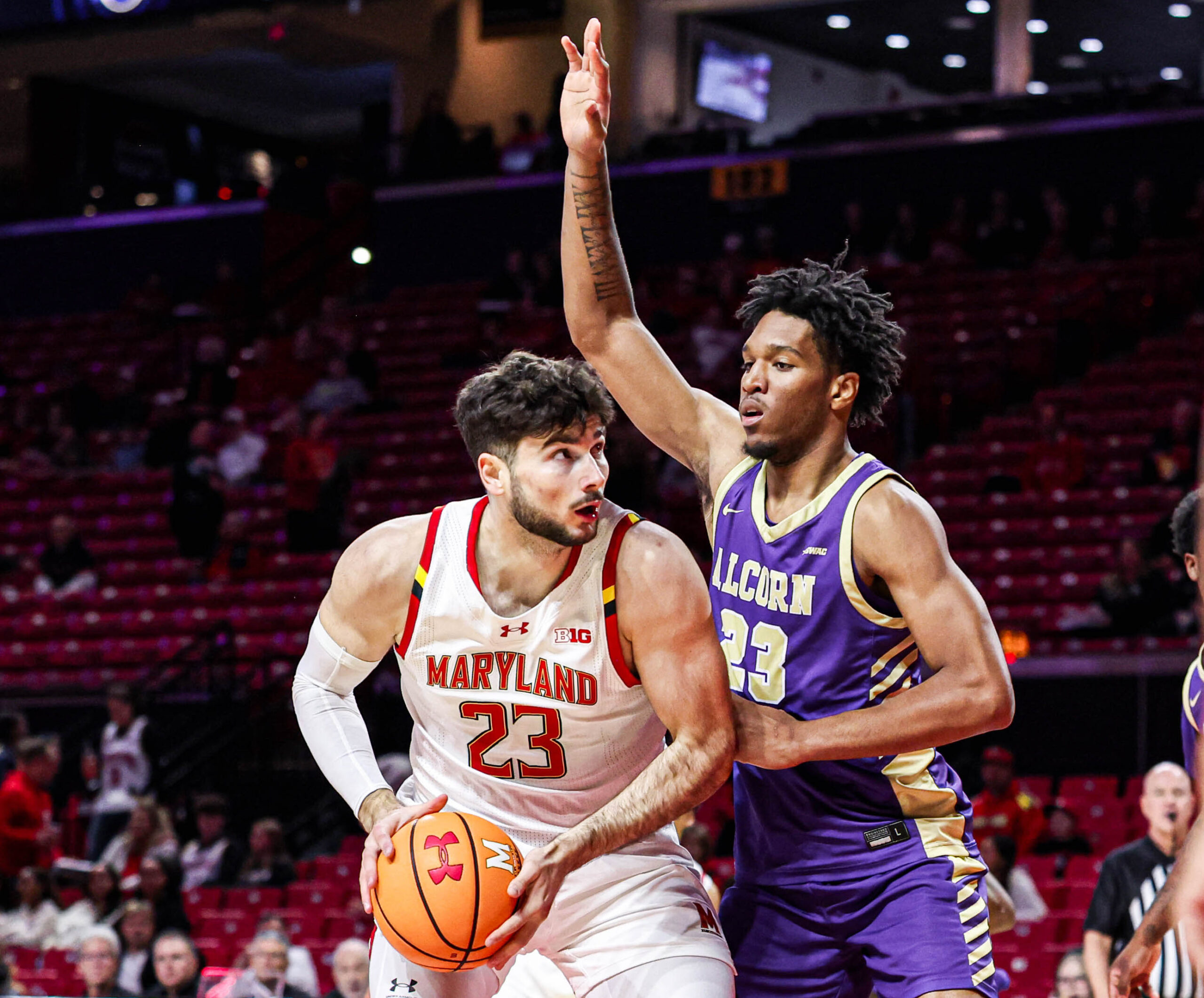
Maryland finally got the offensive performance it had been searching for Monday night.
After consecutive losses to Georgetown and No. 6 Virginia exposed concerns about the Terrapins’ shooting, offensive execution and consistency, Buzz Williams’ team responded with a 117-57 demolition of Alcorn State at XFINITY Center.
The Terps (2-2) shot 62.9 percent from the field, made 15 three-pointers and recorded 26 assists in their most efficient offensive showing of the young season.


Granted, Alcorn State (0-4) offered considerably less resistance than Maryland’s previous two opponents. But after struggling to establish any offensive rhythm against Georgetown and failing to protect an 11-point halftime lead against Virginia, the Terps needed a performance like this.
Here are five takeaways from Maryland’s 60-point victory.
Maryland’s perimeter shooting finally comes alive
Through its first three games, Maryland’s inconsistent perimeter shooting had been one of its most glaring weaknesses.
Against Alcorn State, the Terps looked like a completely different team.
Maryland connected on 11 of 16 three-point attempts in the first half alone, building a commanding 60-30 advantage before intermission. The Terps finished 15-of-30 from beyond the arc, shooting an impressive 50 percent.
R.J. McNair Jr. led the way with four three-pointers, while DJ Wagner and Andre Mills added three apiece. Austin Brown also connected twice from deep.
The shooting performance was particularly encouraging because the production came from multiple players rather than one individual carrying the offense.
Maryland won’t shoot 50 percent from three every night, especially against stronger competition. But the Terps demonstrated they have enough perimeter options to punish defenses that collapse into the paint.
The next challenge is finding that consistency against Big Ten opponents.
The ball movement may be the most encouraging development
As impressive as Maryland’s shooting numbers were, the team’s passing and offensive execution might have been even more significant.
The Terps finished with 26 assists on 39 made field goals while committing just nine turnovers.
That’s a remarkable 2.9-to-1 assist-to-turnover ratio.
Kaden House led Maryland with six assists, while Bishop Boswell and Baba Oladotun contributed four apiece. Andre Mills added three.
Rather than relying on individual drives or contested shots, Maryland consistently moved the ball to create open opportunities. The result was an offense that looked considerably more connected than it had against Georgetown and Virginia.
The Terps also generated 48 points in the paint, demonstrating that their offensive success wasn’t exclusively dependent on outside shooting.
For a team still developing chemistry under Williams, the willingness to share the basketball was an encouraging sign.
The quality of the opponent matters, but the offensive principles Maryland displayed Monday should translate regardless of competition.
Kaden House continues to make his case for a bigger role
Through four games, House has increasingly looked like one of Maryland’s most intriguing offensive weapons.
The freshman guard led the Terps with 16 points against Alcorn State, shooting 5-of-8 from the field and 5-of-6 at the free-throw line.
He also contributed six assists, three rebounds and two steals without committing a turnover.
And he did all of that in just 18 minutes.
House’s ability to attack the basket, create opportunities for teammates and generate offense gives Maryland a different dimension in the backcourt.
His performance against Virginia, when he scored 17 points, had already demonstrated his ability to contribute against high-level competition. Monday offered further evidence that he can impact games in multiple ways.
With DJ Wagner, Boswell and McNair also competing for backcourt minutes, Williams has several options at his disposal.
But House is making an increasingly compelling argument that he deserves a significant role in Maryland’s rotation.
Buljan’s rebounding gives Maryland something it needs
Maryland’s rebounding struggles were a major concern against Virginia, which held a 35-26 advantage on the glass.
Monday’s performance offered a much different picture.
The Terps outrebounded Alcorn State 46-32, with Tomislav Buljan leading the way.
The sophomore forward finished with nine points, 10 rebounds, two assists and two steals in 23 minutes. He made all three of his field-goal attempts and grabbed nine defensive rebounds.

Buljan’s activity was particularly important because Maryland needs consistent rebounding contributions beyond Pharrel Payne.
Against Virginia, the Terps struggled to control the defensive glass and protect the paint. Those problems won’t disappear simply because Maryland dominated an overmatched Alcorn State team.
But Buljan’s combination of size, activity and versatility gives Williams another option in the frontcourt.
His development could become especially important as Maryland prepares for the physical demands of Big Ten play.
The defensive numbers were impressive, but perspective matters
Maryland’s offensive explosion understandably dominated the headlines, but the Terps also delivered their strongest statistical defensive performance of the season.
Alcorn State shot just 26.7 percent from the field and made only one of its 14 three-point attempts.
The Braves finished with 57 points, four assists and 13 turnovers while managing just 0.781 points per possession.
Maryland also limited Alcorn State to 27 second-half points.
Those numbers represent a significant improvement from Friday, when Virginia shot 76.9 percent in the second half and scored 51 points after intermission.
Still, the difference in competition cannot be ignored.
Alcorn State entered Monday winless, and Maryland’s defensive performance against the Braves doesn’t necessarily answer the questions raised by Georgetown and Virginia.
The Terps must prove they can consistently defend the paint, finish possessions with rebounds and maintain their defensive intensity against more talented opponents.
Monday was a positive step, but the real test remains ahead.
The bottom line
Maryland’s 60-point victory was exactly what the Terps needed after a disappointing start to the season.
The shooting was outstanding, the ball movement was encouraging and several young players continued to demonstrate their potential.
Perhaps most importantly, Maryland played with offensive confidence and efficiency for a full 40 minutes.
But one dominant performance against an overmatched opponent doesn’t erase the problems exposed in losses to Georgetown and Virginia.
The challenge for Williams and his team is carrying Monday’s offensive execution, balanced scoring and defensive effort into games against stronger competition.
Maryland has shown flashes of what it can become. Now the Terps need to prove they can sustain it.