
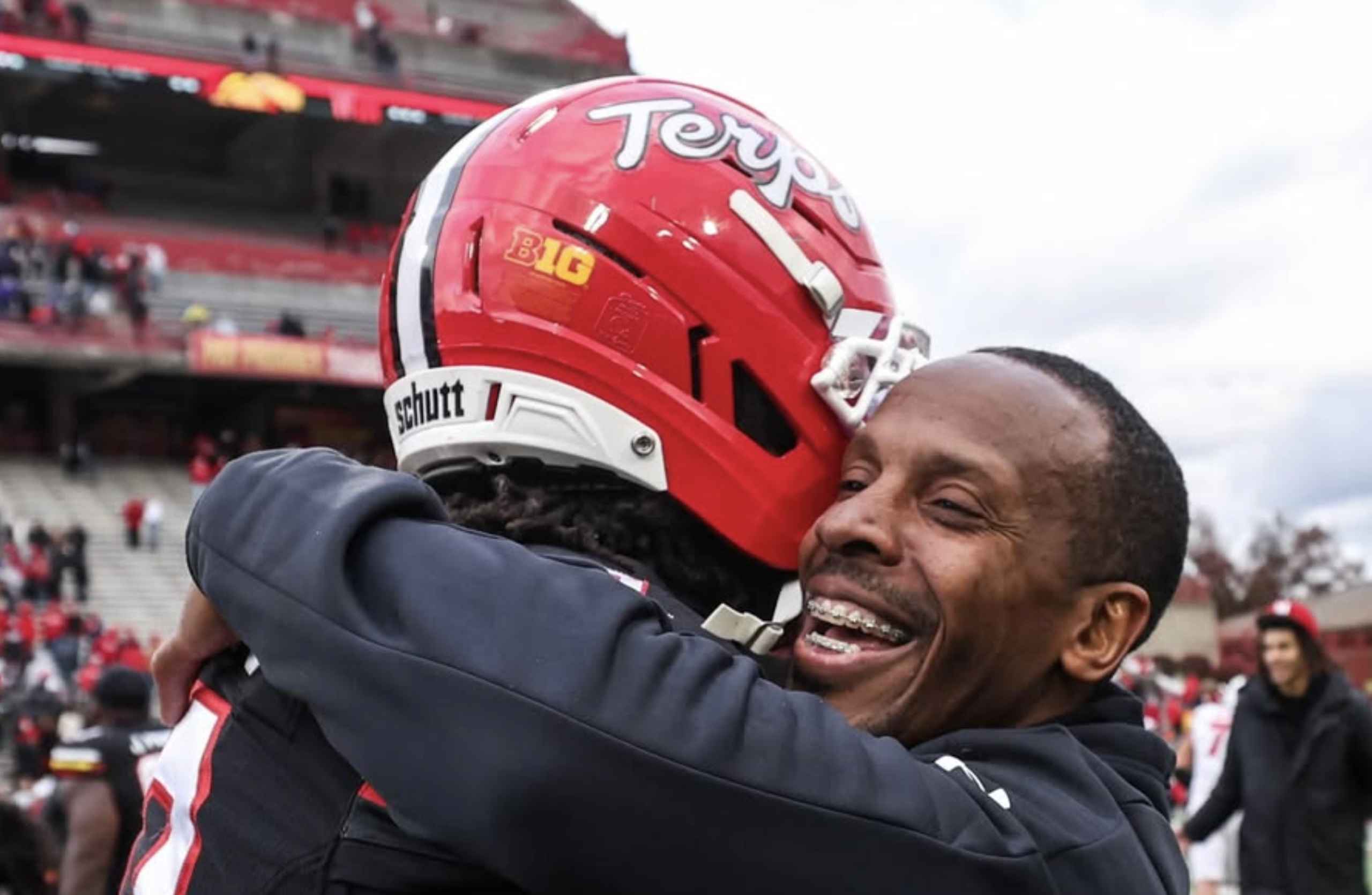
Aazaar Abdul-Rahim has a simple philosophy when it comes to motivating football players.
It’s not fear. It’s not punishment. And it’s not the promise of rewards.
It’s love.
“The highest motivation for me is love,” Maryland’s interim head coach said Monday. “I’m not big on reprimanding or giving incentives-based things. I think they need to know that you extremely care about them.”
It’s an approach rooted in relationships, trust and an understanding that coaching young men involves considerably more than drawing up plays or making adjustments on Saturday afternoons.
And right now, it’s producing results.
After enduring a 13-game Big Ten losing streak, Maryland has suddenly won two consecutive conference games, defeating Purdue on the road and Wisconsin at home. The Terrapins have gone from a team struggling to find answers to one playing with renewed confidence, energy and belief.
Two victories don’t erase everything that went wrong earlier this season. But they’ve provided something that had been missing for much of the fall: tangible evidence that the Terrapins can win again.
And at the center of that turnaround is a coach whose approach to leadership was shaped long before he arrived in College Park.
More than a football coach
Before coaching at Maryland, Abdul-Rahim built his reputation working with young people, including a successful stint as head coach at Friendship Collegiate Academy in Washington, D.C.
He also holds a master’s degree in counseling and previously worked as a high school guidance counselor.
Those experiences continue to influence how he approaches his players.
“I think it starts with just having a passion for people,” Abdul-Rahim said. “I enjoy being around young people. They keep me grounded. They keep me young.”
His counseling background, he explained, taught him the importance of understanding players as individuals rather than treating an entire roster the same way.
“I literally have to dive in individually and really forge individual relationships,” Abdul-Rahim said.
He pointed to quarterbacks Malik Washington and Cardell Williams as examples of players who require different approaches to motivation.
The objective is the same, but the way he connects with each player may be different.
For Abdul-Rahim, that individualized attention isn’t an added responsibility of coaching. It’s the foundation of it.
“They’re still kids,” he said. “They don’t want to let you down when you’re that father figure.”
It’s also why he doesn’t view the transition from coaching high school football to leading a Big Ten program as fundamentally changing his responsibilities.
“Head coaching is head coaching. Leading is leading. It doesn’t change,” Abdul-Rahim said. “They’re still young men and they need guidance. They need understanding. They need compassion.”
Players are responding
The impact of that approach is evident in the way Maryland’s players talk about their interim head coach.
Veteran tight end Preston Howard offered a particularly revealing example during Monday’s press conference.
Shortly after taking over the program, Abdul-Rahim pulled Howard aside for an individual conversation.
“He brought me in early and told me, you know, I need to step up, make some plays,” Howard said. “And he relies on me, and I appreciate him for that.”
It wasn’t a complicated message. Abdul-Rahim identified a veteran he believed could contribute more, communicated those expectations directly and made sure the player understood he had his coach’s confidence.
Howard responded with an equally straightforward endorsement.
“He’s a winner,” Howard said. “You got to love a winner. I love a winner.”
For a team navigating a coaching change in the middle of a disappointing season, those relationships matter.
Players could have checked out. Veterans could have turned their attention toward the end of the season. Younger players could have begun looking ahead to whatever comes next.
Instead, Maryland has continued competing.
Howard insists the team’s commitment to one another never disappeared, even during its losing streak.
“The guys are together. We’ve always stayed together,” he said. “We’re not going to fall apart because of a couple losses. It’s just deeper than football.”
That sense of connection has become an important part of the program’s recent resurgence.
Turning belief into victories
The most visible evidence of Maryland’s renewed confidence came during Saturday’s victory over Wisconsin.
The Terrapins fell behind by 10 points early and trailed by seven late, but continued finding ways to respond.
The defense created three turnovers. Special teams delivered the decisive play. And Williams, making his first career start at quarterback, helped the offense overcome the absence of Washington.
For Abdul-Rahim, the defining characteristic of the performance wasn’t any individual statistic.
It was the team’s refusal to give in.
“Resilience would be the key word,” he said. “We were down 10 pretty early, and then late we were down seven, and it never wavered. The belief never wavered.”
That belief has translated into victories in consecutive November games, something that carries particular significance for a program that had struggled for so long in conference play.
“Winning two straight games in November is a big deal,” Abdul-Rahim said. “November is a tough month. You’ve dealt with injuries, you’ve dealt with sometimes roster attrition.”
He understands how easily a disappointing season can unravel during its final weeks.
Instead, Maryland has found a way to reverse its momentum.
“To win two Big Ten games in November, [I’m] super excited for our kids and their belief,” he said.
Howard sees the victories as something that extends beyond the players currently on the field.
“I think it’s just a big boost in the next year for the guys that want to stay,” he said. “It’s just keeping the locker room together.”
For a program facing questions about its future, finishing the season with a sense of purpose could prove valuable regardless of what happens next.
Leadership starts with the veterans
Abdul-Rahim is quick to acknowledge that his approach wouldn’t work without the cooperation of Maryland’s veteran players.
The coaching staff can establish expectations, but maintaining those standards inside the locker room requires leadership from the players themselves.
And the Terrapins have needed that leadership throughout a season filled with adversity.
“Without the buy-in of the older young men, the leaders, the big brothers of our program, it wouldn’t happen,” Abdul-Rahim said.
Howard has embraced that responsibility.
Asked how he has helped younger teammates navigate the coaching change, the veteran emphasized the importance of continuing to improve regardless of individual circumstances.
“I just try to keep the message that it’s bigger than yourself,” Howard said. “Even if it’s looking down, you’re not playing right now, you always got to try to get better.”
It’s a message consistent with the philosophy Abdul-Rahim has been preaching.
The players must understand that their responsibilities extend beyond their own playing time, statistics or individual success.
And the coach must establish the kind of trust that makes them willing to embrace those responsibilities.
That combination has helped Maryland maintain its sense of togetherness during a difficult season.
A different kind of energy
Abdul-Rahim’s approach isn’t limited to quiet conversations or personal relationships.
He’s an emotional coach who believes the energy on the sideline can influence the performance of his players.
He doesn’t attempt to hide that emotion, even when the cameras are watching.
“When I’m in that moment, I want them to feel me in that moment,” he said.
Football, Abdul-Rahim explained, is a game in which emotion and momentum are closely connected.
He believes understanding those fluctuations—and knowing when to use his own energy to influence them—can help his team.
“This is a game of emotion,” he said. “The momentum sometimes goes up and down by the emotion of the game.”
That energy has extended beyond the sideline.
Maryland’s players have embraced changes to their uniforms and the atmosphere surrounding the program, including wearing black combinations during their recent victories.
Howard said those decisions were made collaboratively by the team’s leadership group and coaches.
“We came to the conclusion, like, we need a different swag out there,” Howard said. “We need something to change.”
His explanation captured the attitude that has accompanied Maryland’s recent turnaround.
“It’s a new season. We just entered a new season. So why not switch it up? Look good, feel good, play good.”
The uniforms haven’t won the games, of course.
But the willingness to embrace something different reflects a team trying to establish a new identity during the final weeks of the season.
Something to build on
There are still significant questions surrounding Maryland football.
The Terrapins remain in the middle of a coaching transition, and the program’s long-term direction has yet to be settled.
Two victories don’t provide definitive answers about what the future should look like.
But they have changed the immediate conversation.
Maryland is no longer simply trying to end a losing streak. The Terrapins are trying to extend a winning one, with a trip to USC awaiting Saturday and the possibility of postseason football still alive.
For Abdul-Rahim, however, the central message hasn’t changed.
He believes in building relationships. He believes in understanding what motivates each player. And he believes young men respond when they know the people leading them genuinely care.
The results of the past two weeks suggest that message is getting through.
Whether Maryland can sustain its momentum remains to be seen.
But for a team that spent much of the season searching for answers, Abdul-Rahim has provided something meaningful.
Not just a different voice on the sideline.
A reason to believe again.