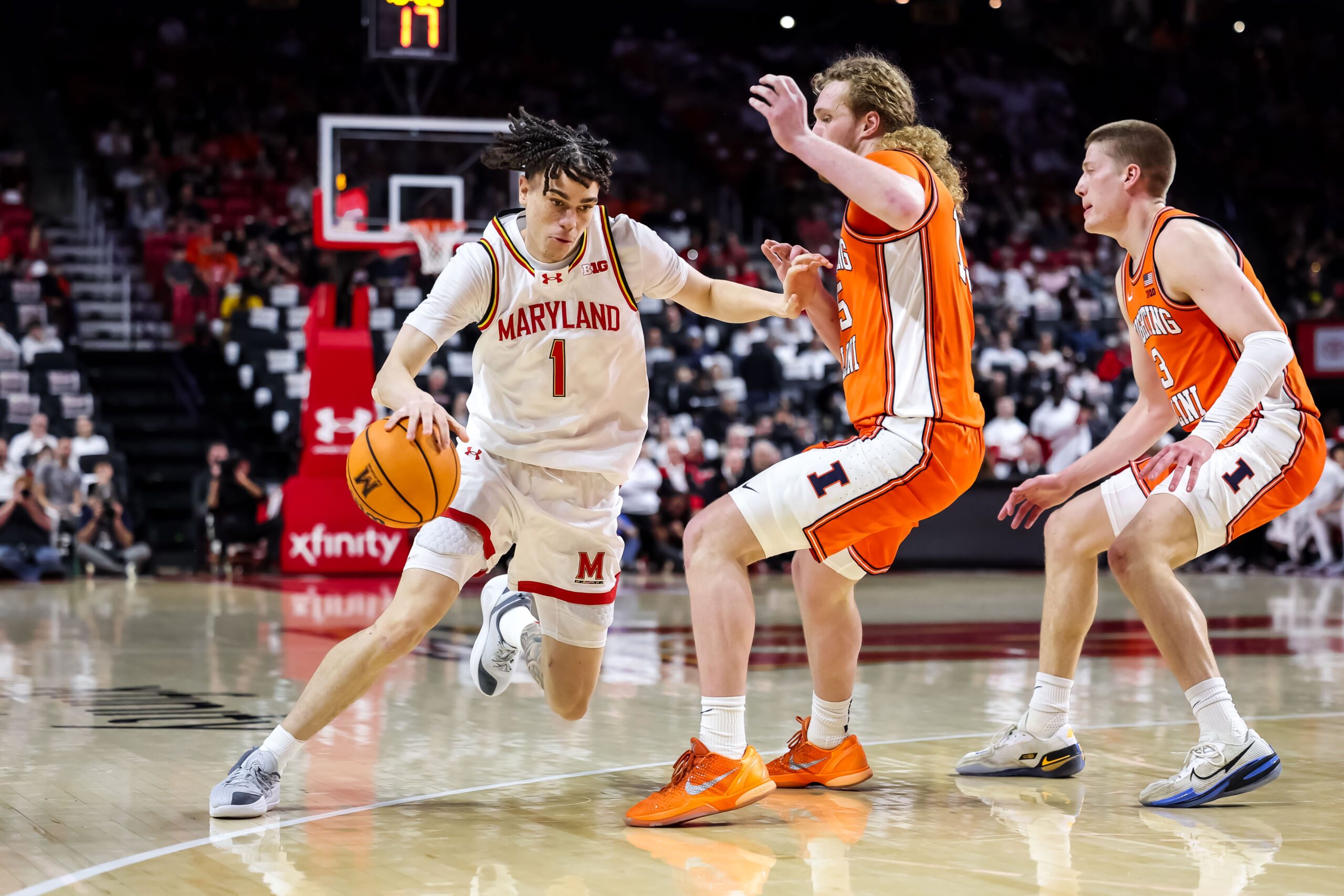

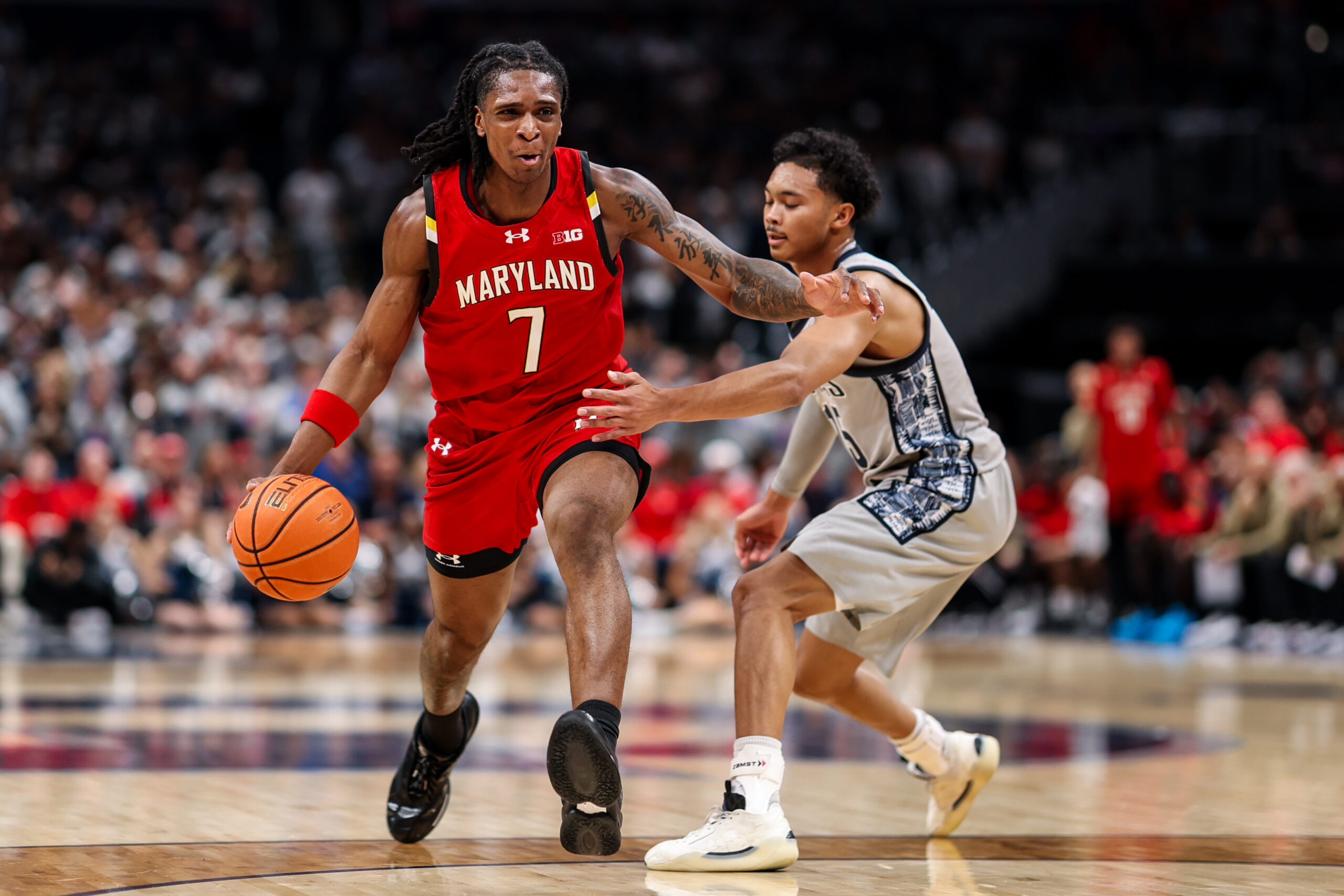
Two games into his second season at Maryland, Buzz Williams is still searching for answers.
The Terrapins opened with a convincing victory over Bucknell before suffering a disappointing 86-74 loss at Georgetown on Saturday. Now, with a talented Virginia team coming to College Park on Friday night, Williams and his coaching staff are trying to determine which combinations work best, how to address the mistakes exposed against the Hoyas and how quickly a roster featuring 10 newcomers can come together.
The problem? Maryland’s schedule isn’t allowing much time for experimentation.
“When you play at Georgetown, when you play No. 6 UVA, you don’t have eight to 10 possessions to go, ‘How do you like that? Rock, you want to change that? I think we ought to try this,'” Williams said Thursday. “There is no try, but you also don’t know exactly.”
It’s a difficult balancing act for Williams, who is attempting to accelerate the development of a largely rebuilt roster while facing the kind of competition that leaves little room for mistakes.
“You’ve got to hurry up and get traction, and you’ve got to hurry up and get traction as fast as you can,” Williams said.
Through two games and 28 practices, the Maryland coach acknowledged that he still doesn’t have a clear picture of which players and combinations will be most effective.
“Our group has 10 new players,” Williams said. “That does not mean all 10 players are going to have a meaningful role in the 200 minutes.”
That uncertainty extends to the starting lineup, which could undergo changes as Williams continues evaluating his options.
But the Maryland coach made it clear that he’s less concerned about who starts games than who is on the floor during their most important moments.
“I’m not as concerned with the starters as I am concerned with who’s going to play the minutes when it counts,” Williams said. “And they all count.”
Williams said the staff has been collecting data from practices, preseason exhibitions and the first two regular-season games, constantly adjusting combinations in an effort to identify the most effective groupings.
The early results have offered contrasting evidence.
“The data from the first game would be really good,” Williams said. “The data from the second game would be really bad.”
For now, it’s simply too small a sample size to draw definitive conclusions.
“I don’t think there’s enough data to suggest who’s best together yet, but we’ve got to continue to flesh that out,” Williams said.
Learning from Georgetown
While Saturday’s loss was a setback, Williams has been encouraged by the response from his players and staff.
Rather than dwelling on the result, the Terps have spent the week studying what went wrong and identifying the adjustments necessary to improve.
“I’ve been really encouraged by how they’ve handled it, how we as an organization have handled disappointment, and how we’re going to respond,” Williams said.
The message has been consistent regardless of the outcome.
“If you win, respond. If you lose, respond,” Williams said. “There’s always information to learn.”
Williams praised the team’s approach during its first two days following the loss, describing the response on Sunday and Monday as outstanding.
He also singled out redshirt sophomore Andre Mills, who has remained in frequent contact with his coach as the team prepares for Virginia.


“I love Andre Mills, and we’ve texted 10 or 12 times since practice has been over,” Williams said.
The communication, Williams believes, reflects Mills’ continued development beyond what happens on the basketball court.
“He’s continuing to grow as a player, but he’s continuing to grow in how he thinks,” Williams said. “He’s continuing to grow in how he processes it.”
That growth is particularly important for a Maryland team still learning how to play together.
Against Georgetown, the Terps struggled to find an offensive rhythm, particularly from beyond the arc, while allowing the Hoyas to connect on 15 three-pointers.
Williams believes the problems were more interconnected than they might initially appear.
“We gave them way too many threes. We didn’t make enough threes,” Williams said. “Why didn’t we make threes, and how did they make so many? I think both of those are connected.”
After reviewing the film, Williams said the coaching staff emphasized how individual mistakes compounded throughout the game, with one breakdown often contributing to another.
“So many things that transpired weren’t to the level they need to be, but nearly all of those things were connected,” Williams said.
It’s a lesson the Terps will need to apply quickly.
A difficult test awaits
Maryland’s next opponent presents an entirely different challenge.
Virginia arrives in College Park with an experienced roster, a productive offense and the kind of continuity Williams hopes his own program will eventually establish.
The Cavaliers’ ability to share the basketball was on full display in their victory over Bucknell, when they recorded 30 assists on 37 made field goals.
Williams has been particularly impressed by Virginia’s playmaking, perimeter shooting and rebounding.
“They are really good,” Williams said. “A lot of what Coach [Ryan Odom] is doing is very similar, but there are some different attributes.”
The Maryland coach also pointed to Virginia’s returning players as a major reason the Cavaliers have been able to establish an identity so quickly.
“Their level of returners is what allows them to have so much traction, and we want to eventually get to that,” Williams said.
For Maryland, the challenge is getting there with a roster that is still largely unfamiliar with one another.
Williams knows that process won’t happen overnight. In fact, his philosophy has long emphasized teaching players how to understand the game rather than simply memorizing plays, an approach he believes produces greater improvement as the season progresses.
“We try to teach our guys how to play more so than we teach our guys a play,” Williams said.
It’s also part of the reason he continues scheduling difficult nonconference opponents. Williams believes those games expose weaknesses that might otherwise go unnoticed against lesser competition, providing valuable information even when the results are disappointing.
“You’re probably going to learn more about your team at Georgetown,” Williams said, comparing the challenge to Maryland’s opener against Bucknell. “Whether that information is good or bad, you’re going to learn that information sooner relative to the level of competition.”
But learning and winning aren’t always the same thing, particularly when a team is still trying to discover its best lineups and establish chemistry.
Maryland doesn’t have the luxury of waiting until February to figure everything out. Virginia is coming to College Park on Friday, and the Terps need answers now.
“But in year number two, in week number two, do we have all of those answers? No,” Williams said.
“Are we at an expedited rate of trying to figure it out? Absolutely.”