
When Maryland interim head coach Aazaar Abdul-Rahim was asked Monday to explain a new practice period known as “Terp Alley,” he initially acted as though he was revealing a closely guarded secret.
“We’re not allowed to talk about that,” Abdul-Rahim joked before laughing and offering an explanation.
What followed was a glimpse into one of the changes Abdul-Rahim has implemented since taking over the Terrapins’ football program following Mike Locksley’s dismissal — a competitive practice environment designed to simulate the pressure, intensity and consequences of game day.
And after Maryland’s breakthrough Big Ten victory over Purdue on Saturday, Abdul-Rahim believes those changes are beginning to pay dividends.
“We wanted to create a little bit more of a competitive environment in practice,” Abdul-Rahim said. “That’s what we call our Terp Alley periods.”
The concept is straightforward: Maryland’s best players compete against one another in situations designed to replicate the most demanding moments of a football game.
“Those are ones versus ones, good versus good,” Abdul-Rahim explained. “We created an environment of competitiveness that can, for the most part, simulate a game.”
Rather than simply running through conventional drills, the Terrapins are practicing specific scenarios that can determine the outcome of a game.
“In certain situations, it could be all fourth down. It could be all two-point plays. It could be just third down,” Abdul-Rahim said. “All of the things that we needed to do better, where you only get a live, intense rep in the game, we wanted to try to emulate that in practice.”
But Terp Alley isn’t simply about increasing the intensity of workouts. Abdul-Rahim has made it clear that how players perform during those periods can have consequences for their opportunities on Saturdays.
“Your execution during those Terp Alleys matters,” he said. “If you’re not executing in Terp Alley, good luck playing in the game, because we’re treating it like a game.”
The emphasis reflects a broader effort to establish a new identity for a Maryland team that struggled through much of the season before Abdul-Rahim assumed control.
When the coaching change occurred, Abdul-Rahim said his staff met to develop a fresh approach rather than simply continuing the routines already in place.
“Our staff got together right when Coach Locks got let go, and we created a blueprint of how we felt we could be successful,” Abdul-Rahim said. “We really didn’t look at what was done before.”
The objective was to introduce something different, something that would challenge the players while giving them renewed energy.
“We wanted to be as imaginative and innovative as possible,” he said. “I think during these types of changes, it’s important to try different things. I think it’s important for the kids to feel something new, to feel a little bit of a breath of fresh air, so to speak.”
A different energy at practice
The players have noticed the difference.
Wide receiver Na’eem Abdul-Rahim Gladding said Terp Alley has brought an additional competitive element to Maryland’s daily preparation, particularly at the beginning of practice.
“It definitely brings a competitive aspect to practice,” Gladding said. “Especially coming to practice, you need energy, you need juice to get things rolling. So when you start off practice like that, guys are fired up.”
For Gladding, that heightened intensity is about more than enthusiasm. It’s also about sharpening the details that can separate successful plays from missed opportunities.
“We have a lot of talent,” he said. “It’s just more about harping on technique that changes the game for us.”
That attention to detail has become an important part of Abdul-Rahim’s message, along with developing the confidence to execute under pressure.
“Things like Terp Alley and just the whole mentality aspect, really,” Gladding said when asked about the team’s increased confidence. “We’re just preaching that if you want to win, you’ve got to have a winning mentality.”
That mentality, he explained, extends beyond simply believing Maryland can compete.
“You’ve got to go out there, you’ve got to be a dog. You can’t fold against any type of pressure. Any opportunity that comes, you’ve got to make the most of it.”
Gladding said the change is evident throughout the program.
“Everybody has that winner’s edge, and it’s showing all around the facility, even just in the staff,” he said. “Everybody has a chip on their shoulder, and I think that’s why we’ve been playing with the confidence that we have.”
Preparing for the moments that matter
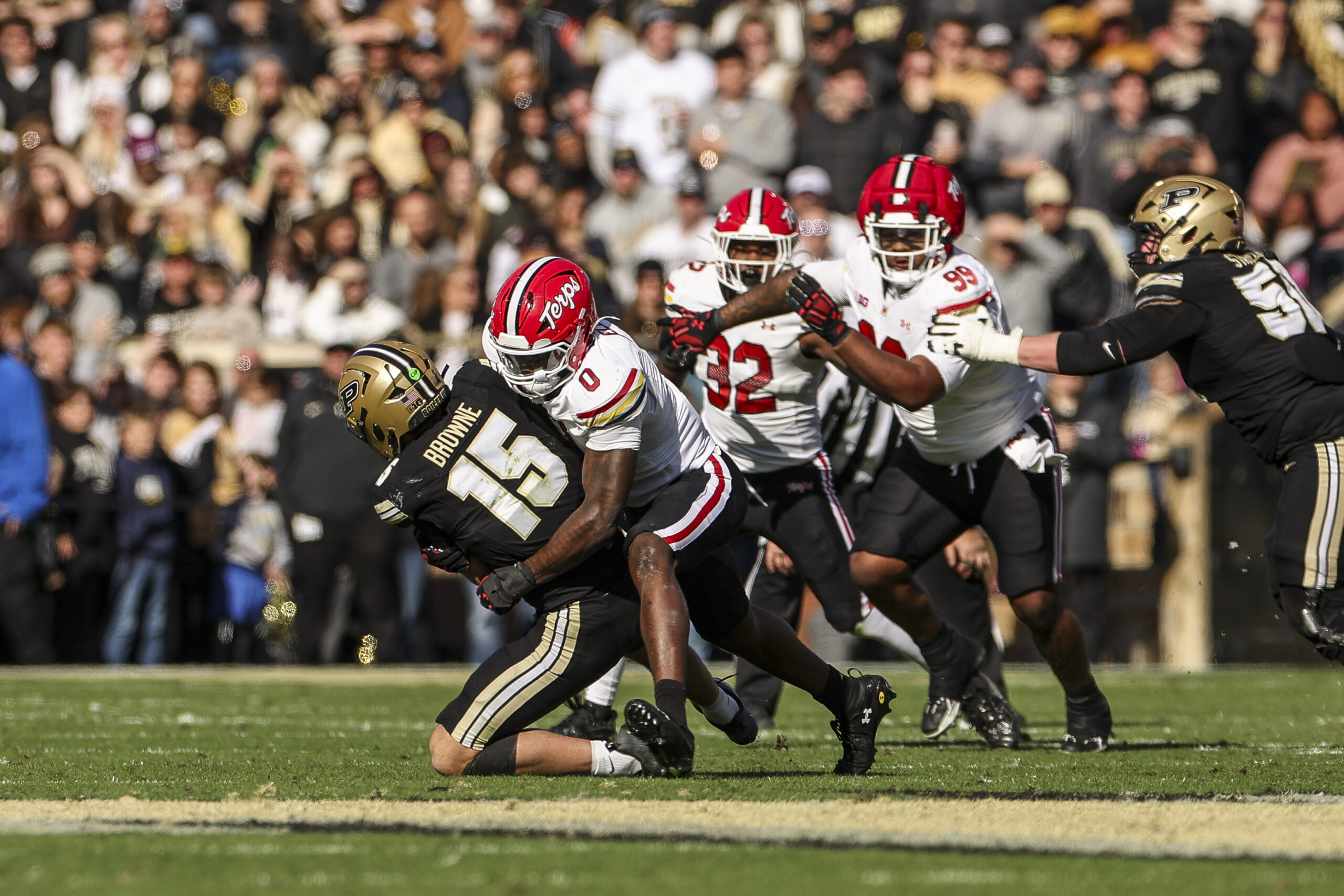
Perhaps the clearest example of what Abdul-Rahim hopes to accomplish through Terp Alley came during Saturday’s victory.
With Purdue threatening late, Maryland’s defense was forced to make the kind of game-deciding stop that had eluded the Terrapins during several close losses earlier in the season.
Abdul-Rahim pointed directly to the team’s preparation when asked how Maryland was able to finish the game.
“The first thing is that I think Terp Alley helps us because we literally have those types of situations, whether we’re on the plus side or minus side of two-minute situations,” he said.
“We have those situations where it’s not uncommon for them to be in that position. I think that helped us.”
The familiarity with high-pressure situations was only part of the equation.
Abdul-Rahim has also emphasized what he calls “brotherhood plays” — moments when players go beyond their individual responsibilities to help teammates succeed.
“The other thing is the brotherhood, where we’re beating them in the head about somebody having to make a play for someone else during that period,” he said.
After reviewing the game film, Abdul-Rahim found so many examples of unselfish effort that he couldn’t include all of them in the team’s meeting.
“I had too many brotherhood clips,” he said. “I couldn’t show all of them in the team meeting because you just see a lot of selfless acts, which is important to the program.”
One example came from freshman defensive end Zion, whose effort chasing down a ball carrier nearly 50 yards downfield impressed Abdul-Rahim even more than his contributions to Maryland’s pass rush.
“Probably his most impressive play was not his sack,” Abdul-Rahim said. “He was a defensive end, and he ran 50 yards down the field and made the tackle.”
The coach explained that the play represented the kind of commitment he wants to see throughout the roster.
“He just did an unselfish act. It really wasn’t just about him. He did that for the team.”
Gladding described similar examples on offense and special teams, pointing to teammates making blocks and sacrificing their bodies to help others make plays.
“Our whole team sees that. We know it, we acknowledge it,” he said. “None of that goes for granted because it’s a physical game, and every play, you never know what could happen.”
Building something beyond one win
Maryland’s victory snapped a 13-game Big Ten losing streak, providing a tangible reward for a team that had endured a difficult stretch.
But Abdul-Rahim isn’t treating the result as a finished product.
“We’re building an identity,” he said. “We don’t have a set culture of who we are on the field.”
That identity, he hopes, will be established through consistent preparation, discipline and accountability rather than the outcome of any single game.
He remains particularly concerned about unnecessary penalties, emphasizing that personal fouls and mental mistakes are unacceptable regardless of the team’s success.
“It’s more the mental errors, the personal fouls. That’s not going to be tolerated,” Abdul-Rahim said. “That’s more about discipline.”
For a coach attempting to change the direction of a program in the middle of a season, the challenge is sustaining the intensity that helped produce the team’s breakthrough.
Abdul-Rahim believes the players have embraced the new approach.
“Probably the biggest thing I’m excited about is, one, the plan is working,” he said. “But they believe, and that’s what I told them in the locker room. They believed in us.”
That buy-in has been particularly meaningful to the interim head coach.
“That’s humbling as a leader,” Abdul-Rahim said.
The Terrapins now turn their attention to Wisconsin, where they’ll have another opportunity to demonstrate whether the changes taking place on the practice field can continue translating into results on Saturdays.
For Abdul-Rahim, the standard remains the same whether Maryland is coming off a victory or a defeat.
“If you’re not executing in Terp Alley, good luck playing in the game,” he said. “Because we’re treating it like a game.”