
Maryland’s first real test of the 2026-2027 season exposed plenty of concerns Saturday night.
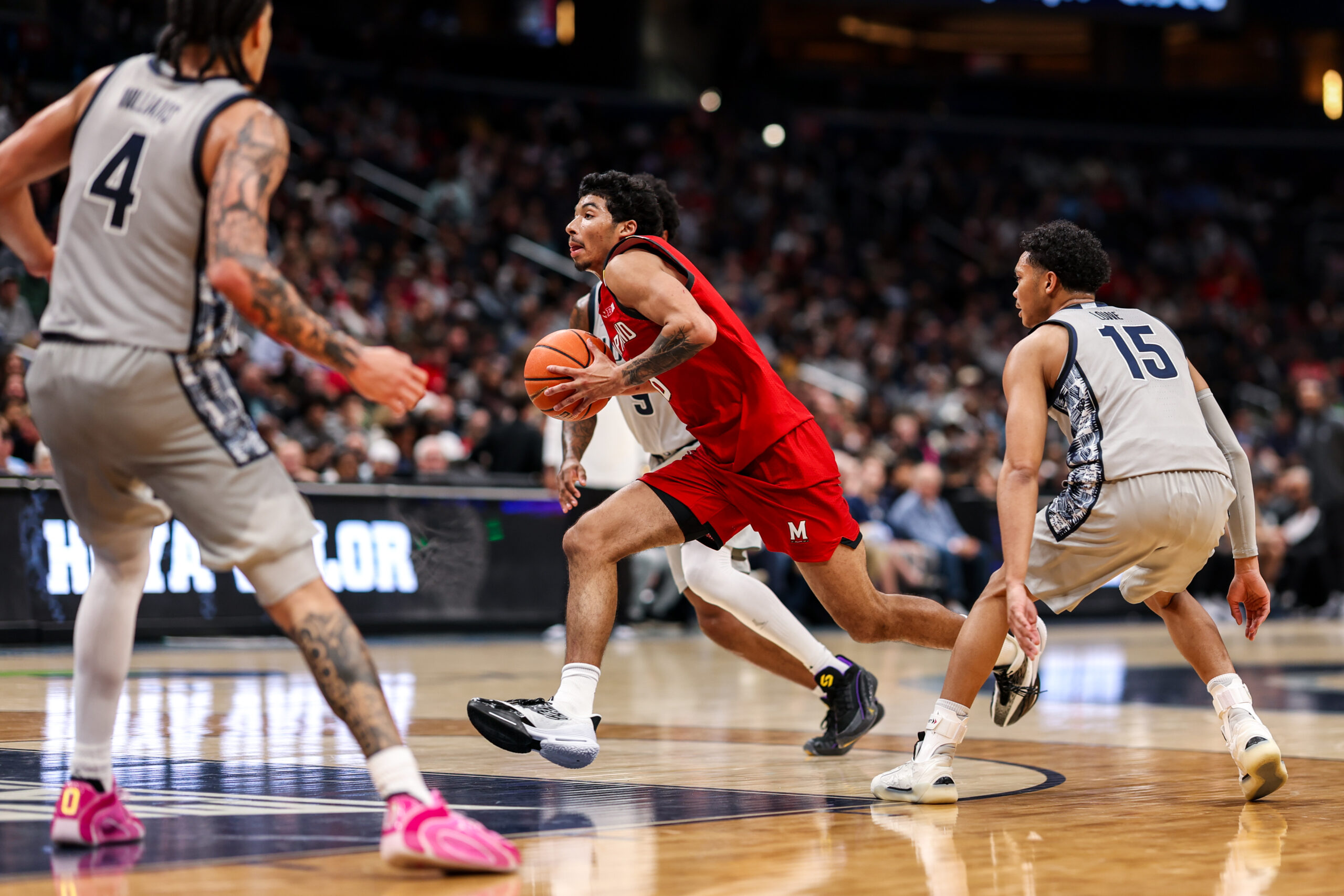
The Terrapins fell to Georgetown, 86-74, at Capital One Arena, but the final margin hardly reflected how thoroughly the Hoyas controlled much of the game. Maryland trailed by 16 at halftime, fell behind by as many as 26 in the second half and needed a late scoring burst to make the final score respectable.


Pharrel Payne was outstanding, but the Terps struggled to generate offense from the perimeter, failed to contain Georgetown’s shooters and had difficulty establishing any consistent rhythm.
Here are five takeaways from Maryland’s first loss of the season.
Maryland’s perimeter shooting is already a major concern
One poor shooting night doesn’t define a season, but Maryland’s performance from beyond the arc raised legitimate questions about the construction of its offense.
The Terps finished just 3-for-20 (15 percent) from three-point range, including a miserable 1-for-11 in the first half. Andre Mills made Maryland’s only three-pointer among the starters, finishing 1-for-7 from deep, while D.J. Wagner missed all four of his attempts.
The problem wasn’t simply that Maryland missed shots. Without a credible perimeter threat, Georgetown could devote more attention to the paint, making it increasingly difficult for the Terps to create space for Payne and their other interior players.
Maryland’s guards also struggled to create quality looks for one another. The Terps recorded just nine assists on 26 made field goals, an indication of an offense that too frequently relied on individual plays rather than sustained ball movement.
Williams doesn’t necessarily need Maryland to become an elite three-point shooting team. But the Terps must become respectable enough from the perimeter to prevent opponents from collapsing defensively.
Pharrel Payne can’t carry the offense by himself
If there was one unmistakable bright spot for Maryland, it was Payne.
The senior center delivered 28 points on 10-for-14 shooting, made all eight of his free throws and collected eight rebounds, including seven on the offensive glass.
It was an impressive individual performance, particularly considering how little consistent offensive support he received.
Payne accounted for nearly 38 percent of Maryland’s scoring. No other Terp scored more than 13 points, and Maryland’s other four starters combined for just 24.
His production also highlighted the difference between Maryland’s interior and perimeter offense. The Terps outscored Georgetown 42-22 in the paint and grabbed 19 offensive rebounds, yet still lost by double digits.
That’s a troubling combination. Maryland generated enough second-chance opportunities to stay competitive, but couldn’t capitalize consistently enough elsewhere.
Payne gives Williams a legitimate interior centerpiece. The question is whether the players around him can provide enough offense to prevent opponents from concentrating their defensive attention on him.
Georgetown’s three-point barrage exposed Maryland’s defensive problems
Maryland’s offensive struggles received plenty of attention, but its perimeter defense was arguably just as concerning.
Georgetown connected on 15 of its 30 three-point attempts, an extraordinary 50-percent performance that repeatedly punished Maryland’s inability to contain the Hoyas on the perimeter.
Jaland Lowe led the way with 22 points and five three-pointers. Kayvaun Mulready also knocked down five triples, while Elmarko Jackson added three.
Those three players combined to make 13 three-pointers.
The Hoyas weren’t simply relying on one hot shooter. Multiple players found opportunities, and Maryland struggled to disrupt their rhythm.
Georgetown also finished with 19 assists on 27 made baskets, compared with Maryland’s nine assists. That disparity illustrated how much more effectively the Hoyas moved the ball and created scoring opportunities.
Not every opponent will shoot 50 percent from three-point range. But Maryland cannot depend on opponents missing open opportunities to compensate for defensive breakdowns.
For a team coached by Williams, whose programs have traditionally emphasized toughness and defensive discipline, Saturday’s performance was particularly concerning.
Maryland won the rebounding battle but lost the game in transition
One of the more revealing aspects of Saturday’s loss was that Maryland actually controlled several categories typically associated with winning basketball.
The Terps outrebounded Georgetown 37-27, collected 19 offensive rebounds and held a 23-20 advantage in second-chance points.
Those numbers suggest Maryland competed on the glass.
But Georgetown held a commanding 23-9 advantage in fast-break points, turning the game into something Maryland frequently struggled to control.
The Hoyas repeatedly found opportunities before the Terps could establish their half-court defense. Maryland’s poor shooting and offensive possessions that broke down late in the shot clock contributed to that problem.
Georgetown also shot 51.9 percent from the field, compared with Maryland’s 41.3 percent.
Winning the rebounding battle means considerably less when the opponent is generating efficient shots in transition and converting half of its attempts from beyond the arc.
Maryland’s physicality on the glass should remain an asset. But Williams must find a way to balance that aggressiveness with better defensive positioning and transition coverage.
Kaden House deserves a longer look, but the rotation remains unsettled
Freshman Kaden House provided one of Maryland’s few offensive sparks, finishing with 13 points in 21 minutes off the bench.
House made all three of his field-goal attempts, including both three-pointers, and went 5-for-7 from the free-throw line.

Most of his production came late, after Georgetown had already built a commanding advantage, so his performance needs to be viewed in that context.
Nevertheless, his ability to create offense and knock down perimeter shots was notable on a night when Maryland desperately needed both.
The broader rotation also warrants attention.
Mills scored nine points but needed 15 field-goal attempts. Wagner finished with 11 points, while starting forward Tomislav Buljan contributed four points and 10 rebounds. Mike McNair Jr. went scoreless in 22 minutes.
Williams experimented with different combinations, but none consistently solved Maryland’s problems on either end of the floor.
With so many new pieces, some early-season inconsistency is inevitable. Still, the Georgetown game demonstrated that Maryland has significant work ahead in establishing reliable offensive roles and finding combinations that complement Payne.
House may have earned additional opportunities, particularly if the Terps continue struggling to generate perimeter offense.
The bottom line
Maryland’s first loss of the season wasn’t simply the result of an unusually poor shooting night.
The Terps struggled with offensive spacing, ball movement, perimeter defense and transition coverage. Payne’s dominant performance and Maryland’s success on the offensive glass were encouraging, but neither was enough to overcome the problems elsewhere.
The challenge now is determining which issues were the product of one difficult night and which represent more fundamental weaknesses.
Maryland won’t have long to figure it out. The Terps return home Friday night for another significant early-season test against a top-10 Virginia team.